starts in
04
days
04
hrs
04
min
Your new workforce won't be all human. Join the

conference to learn how to manage it.
request invite

IT asset management changed roles in 2026. It used to be a system of record: somewhere to log purchases, count licenses, and pass audits. Now it's also a system of context — the live layer AI agents read to decide who gets access, how to route an incident, what will break if a change ships. Spreadsheets and static CMDBs can't feed that loop, and ITAM platforms that haven't built for it are quietly slipping out of the workflow.
What does that mean in practice?
Your asset data is now an AI agent's source of truth. When an AI Coworker handles an access request, an incident, or a software install, it queries the asset layer for who owns the device, what's running on it, and what depends on it. Stale or partial asset data shows up immediately as wrong agent decisions.
SaaS is most of the inventory now. Most enterprises run more active SaaS subscriptions than physical devices. ITAM tools that only see hardware miss the majority of the spend and the bulk of the renewal risk.
Lifecycle runs continuously, not annually. Devices arrive, get reassigned, get reclaimed, get refurbished. Subscriptions auto-renew, contractors come and go. The tools that work in 2026 treat lifecycle as a live workflow, not a quarterly clean-up.
In this guide, we compare the top IT asset management tools for 2026 and how they fit modern IT environments.
How we built this list
Here are the top ITAM tools at a glance:
Asset management tools | best for |
Atomicwork | AI-powered asset lifecycle management |
IBM Maximo | Enterprise-grade asset management with condition-based maintenance |
ServiceNow | Enterprise asset management with real-time insights across various asset types |
SolarWinds | Automated discovery and inventory tracking with deep integrations |
Asset Panda | Customizable workflows for tracking digital assets across industries |
ManageEngine | Software compliance and asset discovery with CMDB capabilities |
Flexera | Organizations requiring sophisticated hardware and software asset management |
Jira Service Management | Ideal for companies with other Atlassian tools |
SysAid | Asset discovery and service desk integration with network scanning capabilities |
Ivanti | Real-time asset discovery for complete lifecycle tracking |
BMC Helix Discovery | Cloud and on-premise asset insights with AIOps |
NinjaOne | Automated asset discovery and management with detailed reporting and searchability |
Atomicwork offers comprehensive asset management capabilities for IT teams to track and manage assets’ lifecycle end-to-end–from purchase to disposal.
Key features:
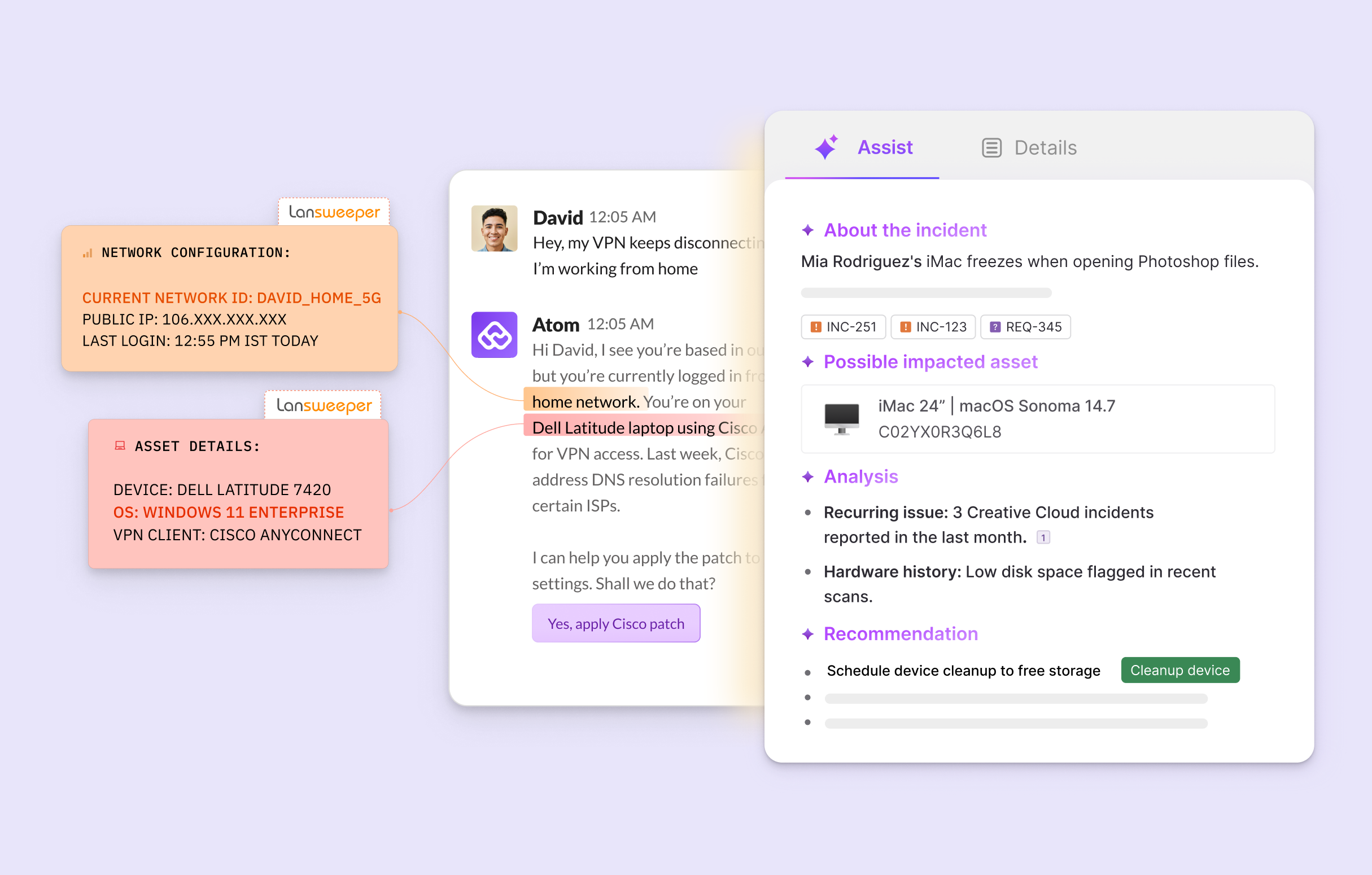
Why Atomicwork?
Atomicwork is an all-in-one, modern ITSM solution that organizations can use to deliver exceptional employee experiences. Built with AI from the ground up, Atomicwork has automated asset, incident, request, and change management capabilities, making it a complete ITSM platform for modern enterprises.
Being a centralized platform, IT teams can easily manage asset relationships, linking requests, incidents, and changes to impacted assets—or raising an incident or change directly from the asset itself. Atomicwork can also be synced with leading device management like Intune, Iru (formerly Kandji), Jamf, JumpCloud, or popular asset discovery tools like Lansweeper.
Sign up to experience context-rich asset management in action!

IBM Maximo is a leading enterprise asset management solution known for its extensive functionality and scalability. Their robust AI-based monitoring helps fix problems before they even start by using condition-based maintenance.
Key features:

ServiceNow's Asset Management system provides end-to-end visibility into assets, helping organizations optimize asset usage and reduce costs. They also allow employees to use their mobile devices to request assets, see assigned assets, and report incidents—anytime.
Key features:

SolarWinds Asset Management offers automated asset discovery, inventory tracking, and software license management.
Key features:

Asset Panda is a cloud-based asset tracking and management tool that different industries can use to maintain several types of digital assets. They have extensive integrations and logging features that IT teams can use for efficient asset management.
Key features:

You can manage IT Assets, non-IT assets, asset components, software and groups with Manage Engine’s Asset Explorer. They also include software license compliance and software forecasting in their product offerings.
Key features:

Flexera FlexNet Manager Suite specializes in software asset management (SAM) and SaaS spend optimization, helping organizations control licensing costs and maintain compliance across on-premise, SaaS, and cloud environments. It is best suited for organizations with complex licensing models and vendor contracts.
Key features:

Jira Service Management offers limited IT asset management capabilities, including asset tracking, inventory management, and procurement workflows.
Key features:

SysAid combines IT service management with built-in asset discovery, making it suitable for service-desk-led IT teams, particularly in small to mid-sized organizations. It prioritizes ease of use and quick deployment over advanced lifecycle automation.
Key features:

Ivanti Neurons provides real-time asset discovery and normalization across endpoints, servers, cloud, and software environments. It is well-suited for organizations that need strong endpoint visibility combined with service management workflows.
Key features

BMC Helix Discovery focuses on asset discovery and dependency mapping across hybrid IT environments. It is commonly used alongside ITSM platforms to improve visibility into complex infrastructure landscapes.
Key features:

NinjaRMM is a remote monitoring and management platform with built-in asset visibility, making it ideal for IT teams managing distributed and remote devices. It emphasizes speed, searchability, and operational efficiency.
Key features
Choosing an IT asset management tool in 2026 is less about feature checklists and more about fit with how your IT team operates. Before evaluating vendors, consider the following factors:
1. Problem relevancy: Start by identifying what you primarily need to manage. Some tools are built for physical or operational assets, others focus on software licensing and SaaS spend, while modern ITSM-native platforms manage assets in direct connection with incidents, requests, and users. Choose a tool that aligns with your dominant asset challenges.
2. Scalability across modern IT environment: Your business is likely to grow more with time. Hence, it is advisable to get a tool that can accommodate your organization's future growth; be it with the number of assets, different software and hardware, more geographies, and so on.
3. Integration with your IT ecosystem: All great B2B tools have great integrations. When searching for an IT asset management tool, look for compatibility. Select a tool that can be integrated easily with your existing systems and software.
4. Security, compliance, and audit readiness: It is better to be safe than sorry. When searching for the tool, prioritize those that offer robust security measures. Learn in detail about their licenses, updates, data protection policies, and regulations related to third-party sharing.
5. Lifecycle depth and service context: Look beyond inventory tracking. The most effective ITAM tools support the full asset lifecycle—from procurement to retirement—and link assets to service activity so IT teams can understand impact, prioritize issues, and plan proactively.
Selecting the best asset management tool for your organization requires careful consideration of your specific requirements, budget, and long-term goals. More than the number of features, look for relevancy. A good tool fits like a glove to your business needs.
Want to learn if Atomicwork is the right ITAM tool for your organization? Get in touch with us and we will be happy to help you figure it out.