9 benefits of AI service management in 2026, and why they matter more than ever

AI service management has moved from experimentation to execution. It is now becoming foundational to how modern IT organizations operate.
The question is no longer whether AI belongs in service management. It is how well it is embedded into workflows, decision-making, and governance. Organizations that get this right are seeing measurable gains, and those that do not are struggling to scale past pilots.
Atomicwork's State of AI in IT 2026 report makes this shift unmistakable. 98% of organizations are already using AI or actively planning pilots, and 82% of IT professionals say they have realized value from AI investments . The difference now lies in execution.
These nine benefits that we are listing below will help clarify what effective AI service management looks like in practice. They highlight the outcomes organizations realize when AI is embedded into workflows, decision-making, and governance.

1. Faster, data-driven decision-making
The most significant benefit of AI service management in 2026 will be speed of decision-making.
Nearly half of IT teams report faster, data-driven decisions as the top realized benefit of AI. This reflects a shift away from manual analysis and fragmented dashboards toward AI systems that continuously synthesize signals across tickets, infrastructure, applications, and user behavior.
Instead of reacting after incidents escalate, teams can assess impact, prioritize actions, and resolve issues with far greater clarity.
This trend aligns closely with broader enterprise findings. McKinsey’s State of AI research shows that organizations embedding AI directly into decision-making workflows and executive priorities, rather than treating it as an analytics add-on, are far more likely to redesign processes and capture measurable value. High-performing organizations that report real business impact from AI are nearly 3X more likely to have redesigned workflows around AI compared with others.
Decision intelligence, not task automation, is where that transformation begins.
2. Higher employee productivity through AI-augmented workflows
AI service management continues to deliver tangible productivity gains, with around 40% of organizations reporting improved employee productivity tied directly to AI adoption.
What we will see changing in 2026 is how that productivity is achieved. The biggest gains will no longer come from eliminating individual tasks. They come from AI augmenting entire workflows: suggesting next steps, retrieving context, and reducing the cognitive load on service teams.
Crucially, according to our survey, most organizations are not pursuing full autonomy. Instead, they rely on human-in-the-loop models where AI recommends actions and people retain final control.
This approach mirrors Gartner’s view of AI in IT service management, which emphasizes augmentation over replacement. Gartner defines AI ITSM applications as tools that extend workflows using analytics and automation, rather than systems that remove human decision-making entirely.
3. Improved employee experience with proactive, contextual support
Employee expectations of IT support have risen sharply. Always-on availability, faster responses, and proactive updates are now baseline expectations.
Yet only 25% of end users say they are fully satisfied with IT support today, highlighting a persistent experience gap.
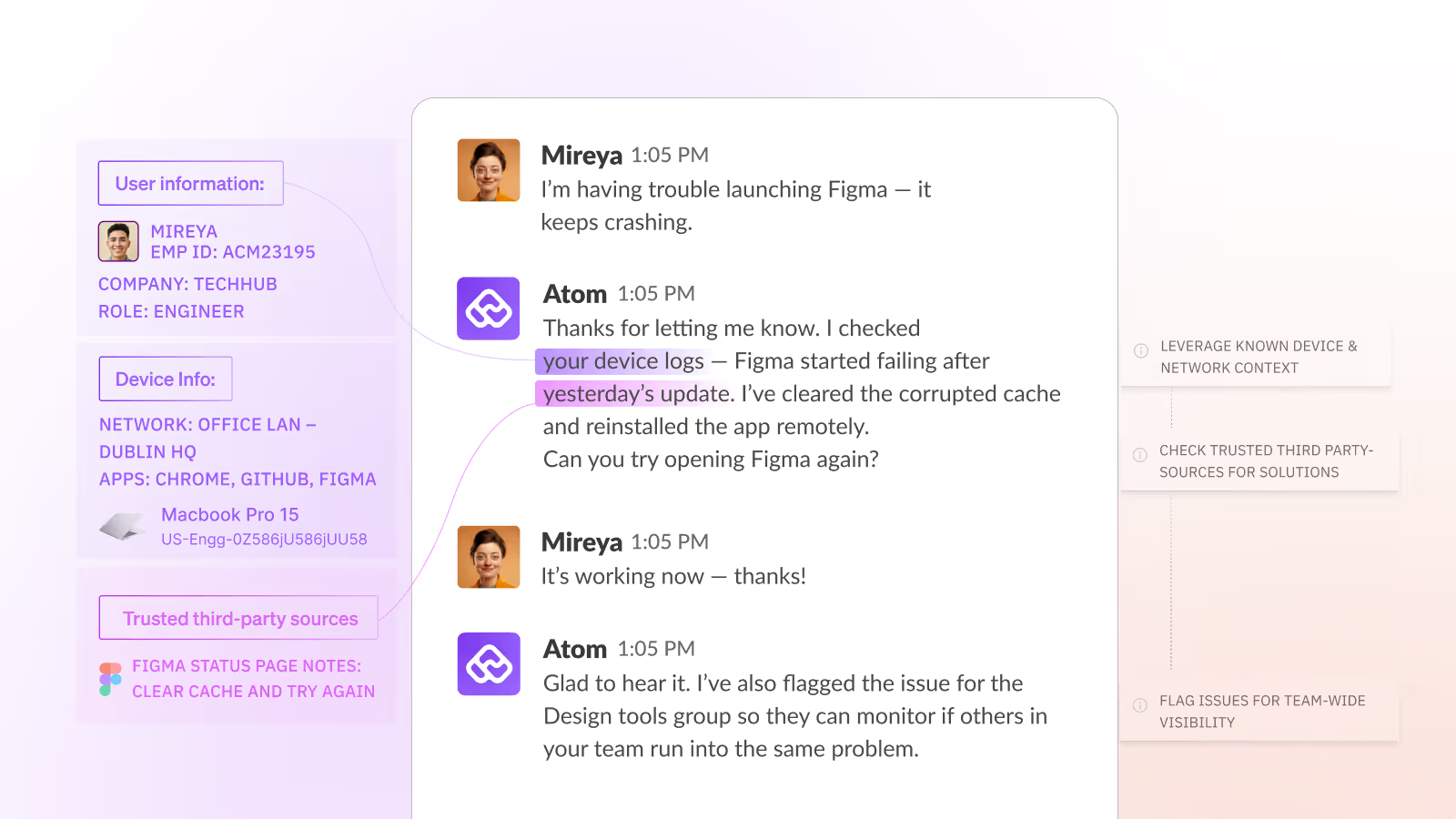
AI service management helps close this gap when it is applied across the full service lifecycle. AI systems that maintain context across channels, keep users informed, and escalate intelligently deliver far better experiences than isolated chatbots or rule-based automation.
The result goes beyond just faster support, it becomes more predictable and trustworthy.
4. Operational efficiency without brittle automation
Automation has long been a goal of service management, but brittle, rules-based automation often created as many problems as it solved.
In 2026, AI will enable a different kind of efficiency. Instead of rigid workflows, organizations will use AI to orchestrate work dynamically, adapting to changing conditions, priorities, and dependencies.
This shift explains why automation and workflow orchestration rank among the top areas where AI has had the most impact in service management. Efficiency gains are now driven by adaptability, not just speed.
5. Stronger knowledge management and faster incident resolution
Knowledge fragmentation has long slowed down IT teams, and AI is finally addressing this problem at scale.
In our survey, knowledge management and incident management rank among the most impacted areas of AI adoption, with AI helping teams search, summarize, and connect information far more effectively than traditional systems.
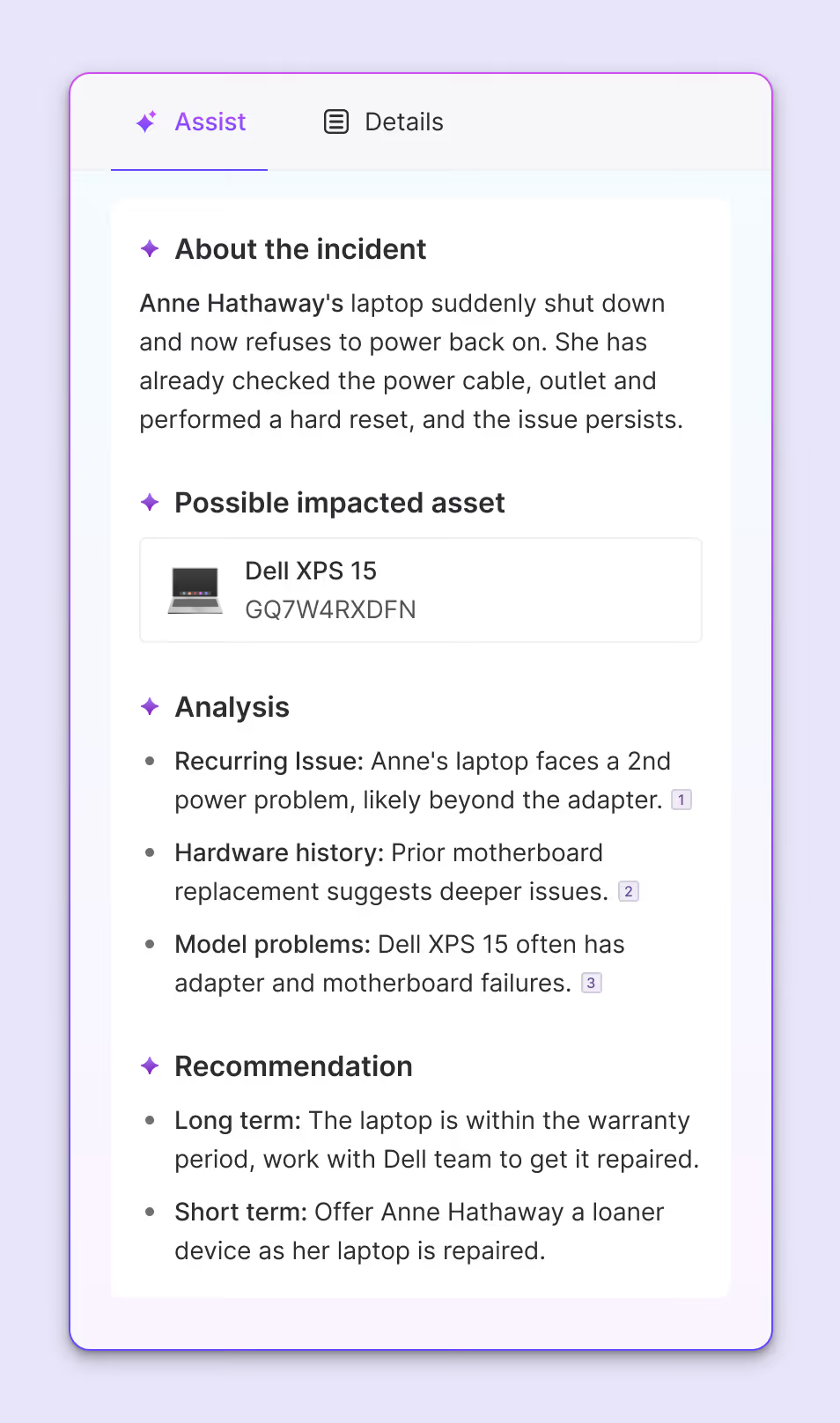
AI-driven root cause analysis, pattern detection, and contextual knowledge retrieval significantly reduce time to resolution, especially in complex, multi-system environments. For instance, Atomicwork provides contextual agent assistance that pulls up impacted assets, incident hsitroty, suggested soultion, and RCA - all powered by AI.
6. Better scalability across IT and enterprise services
AI service management is no longer confined to IT alone. Leading organizations are extending AI-driven service models across HR, facilities, finance, and other internal services.
This cross-functional scalability is reflected in adoption data showing AI integrated across multiple service management teams in more mature organizations.
The benefit is consistency. Employees experience a unified service layer, while organizations reduce duplication and operational silos.
7. Increased trust through explainable, governed AI
Trust has emerged as a defining benefit of mature AI adoption.
Trust in AI has increased for 62% of IT professionals, while only 5% report a decline. This improvement reflects better governance, clearer boundaries, and more transparent AI behavior.
Organizations that invest in explainability and oversight see higher adoption and stronger ROI over time. Atomicwork adopts the TRUST framework to ensure that there are Transparent, Responsible, User-centric, Secure, and Traceable actions while adopting AI in our platform.
8. Reduced risk from shadow AI and unmanaged tools
Shadow AI has become a major concern. 82% of end users report using tools like ChatGPT that were not procured by IT, often on a weekly basis.
When left unmanaged, this kind of AI usage can introduce real risk, from sensitive data being shared with external models, to inconsistent or unverified outputs influencing decisions, to compliance gaps created by the lack of auditability and policy enforcement.
AI service management platforms, like Atomicwork, help mitigate these risks by bringing AI usage under clear governance without blocking productivity. This includes defining where and how AI can be used, enforcing data and access policies, maintaining audit trails, and keeping humans in the loop for high-impact actions.
In practice, reducing shadow AI is less about restriction and more about enablement. When governed, trusted AI tools are easier to access than unmanaged alternatives, employees naturally adopt them and risk declines as a result.
9. Clearer alignment between IT outcomes and business impact
Perhaps the most strategic benefit of AI service management in 2026 will be improved alignment between IT activity and business outcomes.
Organizations increasingly view AI not as a cost-saving mechanism, but as a growth and differentiation lever. BCG notes that as AI capabilities mature, IT budgets are shifting away from pure cost avoidance toward strategic impact and competitive advantage.
This shift elevates IT from a support function to a value driver, with AI acting as the connective tissue between operational execution and business priorities.
What this means for IT leaders in 2026
Taken together, these nine benefits reveal a clear pattern. AI service management delivers the most value when it improves decision speed, scales consistently across services, operates within strong governance, and ties IT activity directly to business outcomes.
Organizations seeing sustained impact are not using AI as a layer on top of service management. AI-native ITSM platforms like Atomicwork are redesigning how work flows, how decisions are made, and how trust is maintained, with AI embedded throughout the service lifecycle.
For IT leaders, the lesson is straightforward. The advantage does not come from adopting AI early or broadly. It comes from using AI deliberately: to augment decisions, reduce operational friction, govern usage at scale, and elevate IT from a support function to a strategic driver.