Guardrails, sustainability, and the role of change management in healthcare IT


Few careers span the creative wonder of Walt Disney to the life-and-death stakes of healthcare IT. Gary Ahwah has done both, and the contrast shaped everything about how he approaches technology leadership today.
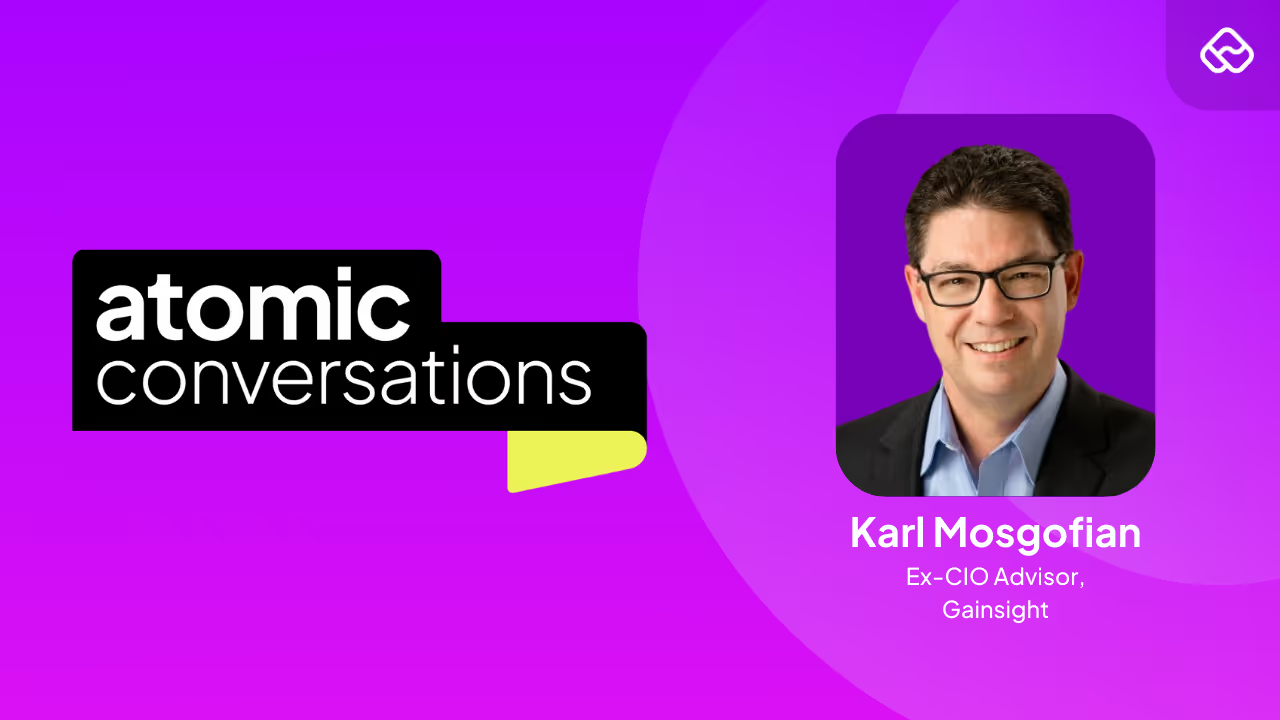
In this episode of Atomic Conversations, I sat down with Gary Ahwah, former SVP and CTO of Molina Healthcare and board member of Human I-T, to discuss what healthcare taught him about technology leadership, why GenAI is driving unprecedented business engagement, and why the fundamentals of change management never go out of style.
Read on for the highlights of our insightful discussion or I'd highly recommend listening to the full conversation here.
From Disney magic to healthcare reality
Gary’s decade at Disney coincided with explosive growth, from $3 billion to $12 billion, spanning theme parks, Disney Stores, and theatrical productions like The Lion King. It remains, in his words, “the most exciting part of my career.”
But healthcare was beckoning him.
I always thought of healthcare as a sector that historically lacked the kind of automation and efficiencies that software brings. Being part of that is rewarding because, at the end of the day, we are taking care of patients and family members. It is an industry where you can make a huge difference in people’s lives. - Gary Ahwah, former CTO of Molina Healthcare
When asked what the difference is between the two worlds, Gary is quick to point out that it's the freedom to experiment.
“Disney is a creative company where you have more freedom to experiment and innovate visibly. Healthcare impacts lives directly, so the guardrails must be completely in place. Healthcare is naturally slower because you cannot risk harming anyone.”
Gary doesn’t mince words about the stakes in healthcare IT: “It is life and death. If our systems go down in a care delivery environment, an operating room, which is driven by technology, cannot function.”
This reality demands what he calls “significant resiliency”: backup procedures, paper-based contingencies, and infrastructure that simply cannot fail. Having worked both care delivery (Kaiser Permanente, City of Hope) and payer sides (PacifiCare, Molina), Gary understands the ecosystem’s dependency on technology.
AI brings the business side to the table
What surprised Gary most about the current AI revolution isn’t the technology itself, it is who’s showing up to the conversation.
“In the AI space, I have noticed our business partners are more engaged than ever before, learning about the technology and participating in the work. We are seeing a convergence where technology leaders are taking on more business-functional understanding.”
But in healthcare, enthusiasm meets caution. Gary advocates for a “human in the middle” approach, deploying AI only with valid use cases and complete understanding of ramifications.
We will not use AI until we are comfortable with valid use cases to ensure we are not harming patients. We need guardrails and a full understanding of the ramifications.
Under Gary’s leadership, Molina became one of the few healthcare companies operating 100% in the cloud, a move driven as much by sustainability as efficiency.
“In a private data center, servers might run without being used; in the cloud, we manage our footprint more tightly, which also reduces costs.”
He extends this thinking to AI: “This now applies to AI and how we consume tokens. We have to be smart about performance and consumption.”
The fundamentals never change
Despite witnessing every technology wave from the early internet to agentic AI, Gary remains grounded in a fundamental truth: change management is still the hardest part.
“I sometimes think an era of tech will be over, but then I am amazed by new things popping up. However, the same fundamentals apply: change management and the adoption challenge remain at the forefront.”
Gary’s counsel for the next generation cuts against the grain of technical obsession.
“Think of it as running a business. Your IT is a business with people, budgets, and a product. By the time you are a CIO, the technology part should be the ‘easy part’, it is table stakes. Focus on managing people, getting the right talent, and communication.”
If you enjoyed skimming through the highlights, listen to our full conversation.