The biggest ideas from

all in one place.
read the recap





AMMEX Corporation is a US-based safety gloves distributor founded in 1988 and headquartered in Seattle, WA. With around 190 employees spread across North America, the Philippines, and Southeast Asia, Ammex is a lean operation. Their IT team manages infrastructure, help desk, and ERP systems across offices, with an increasingly ambitious AI roadmap.
Ammex Corp’s journey with service management tools began with Jira Service Management, which provided a solid foundation for thier various IT service needs. However, it soon became apparent that it lacked the flexibility and advanced AI-driven features that Ammex required to scale efficiently.
The strategic push towards a more automated system that was self-service-first came from Chad Ghosn, Ammex’s CIO and CTO, who emphasized the need for a tool that would drive employees to find their own answers without increasing headcount.

When I talk about automation with a lot of excitement, it's because I know firsthand how much manual work it can take out of a help desk person’s day who started at Ammex over ten years ago as a help desk technician and now manages the team from Manila.
“We wanted to upgrade our ITSM solution with a conversational AI system — something that could handle basic and repetitive inquiries using our knowledge base, without needing a teammate to step in,” he explained.
But Jira wasn’t solving this problem for them. While their initial goal was to achieve simpler integrations between their existing IT systems—like Azure Data Warehousing, Salesforce, Great Plains, and other O365 applications—the available add-ons were limited in scopeand were prohibitively expensive.
The complexity and cost of maintaining Jira Service Management were growing concerns, and the team needed a solution that addressed both their AI ambitions and their day-to-day operational needs. Atomicwork integrated natively with their Microsoft stack — Azure AD, Intune, and crucially, Microsoft Teams, where Ammex's employees already spent most of their working day.

The migration reinforced that confidence with their IT help desk fully operational on Atomicwork within two months. People operations including HR, logistics, and finance followed shortly after. What started as an IT tool quickly became the backbone of service management across the company — today, nearly 20 teams use Atomicwork for everything from help desk requests to logistics and finance workflows, each one finding new ways to streamline how they serve employees internally.
When Atomicwork rolled out in early 2024, the priority was deflection: the percentage of conversations where the Atom could answer without involving a human agent or creating a ticket.
Early use cases were mostly FAQ-driven and often HR-related. When is the next pay period? Can I get the Ammex letterhead?
"We asked every team onboarded to Atomicwork to create documentation for the things that people normally ping you for. Instead of just pinging you, provide a document, and Atom can surface it."
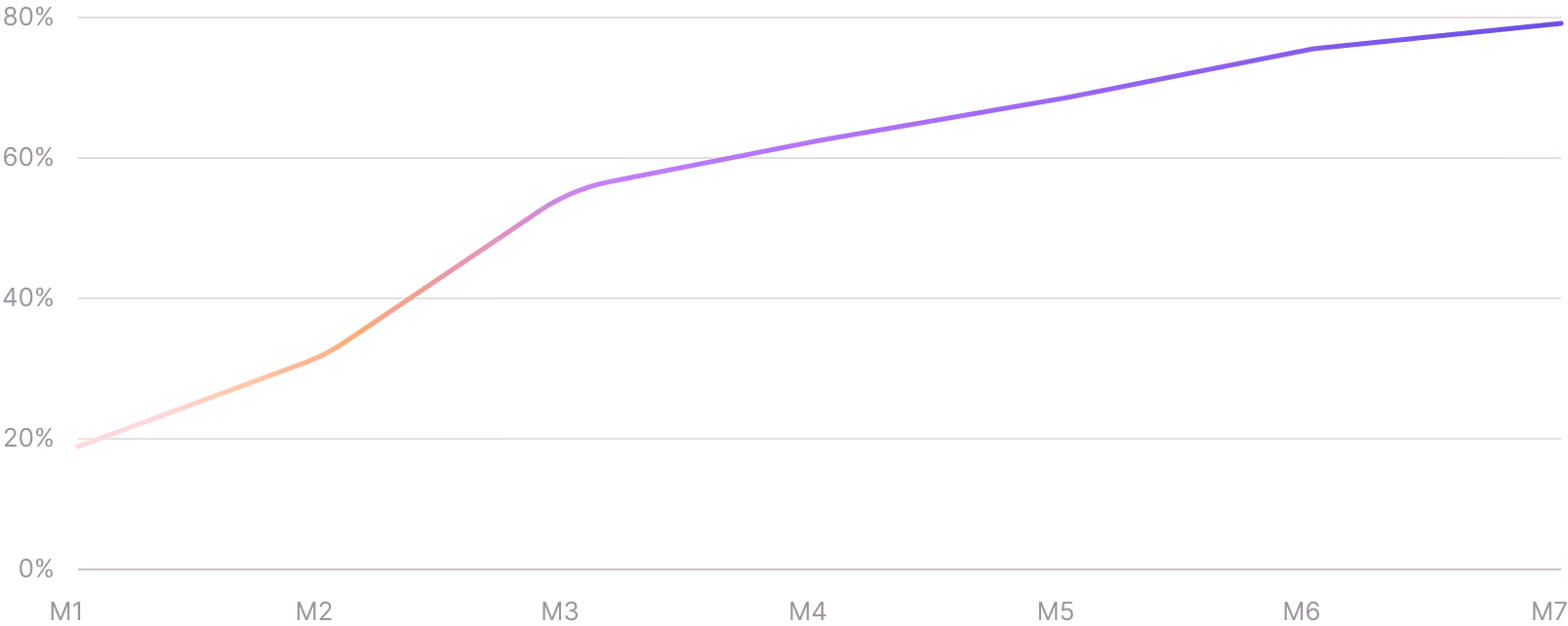
The impact was significant. Deflection rates climbed from 20% to 65%, with a target of 80% through continued documentation refinement.
But Ammex is a small shop with a lot of tenured employees and everyone wearing multiple hats. "When people have years of stock knowledge in their heads, they don't always ask Atom for information," Rinno says. "They tend to file tickets when they know they really need someone to do an action for them."
While deflection was handling FAQs well, what was actually landing on the help desk was action-oriented — requests that needed someone to approve, log into a system, and do something that often took no more than 5 minutes.
For AMMEX's IT team, where request resolution is only a fraction of their day, even a “5-minute” interruption in the middle of deeper work costs far more than five minutes. So the question became: when a request comes in, how much of it can we automate? Ideally, all of it — no human touch at all. But even automating half the steps would be a win. And it didn't take long for that thinking to be put to the test.
Had that request been automated, all Rinno would have needed to do was tap "Approve" on his phone — right there in the restaurant — and the request would have resolved itself.
Rinno didn't start automating at random. Early in 2025, his team went through every request filed in Atomicwork — roughly 2,000 of them.
"I know that number looks a lot, but a lot of times you're just scanning the title and description, and some of them are just similar. If you're very familiar with how your system works, you can already know intuitively which ones require manual work and which ones can be fully automated."
After a week of review, the team had a shortlist of 25 use cases. Some happen constantly; others come up only five or ten times a year. But the filter wasn't frequency alone — it was whether the work could technically be automated, and whether automating it would free meaningful time.
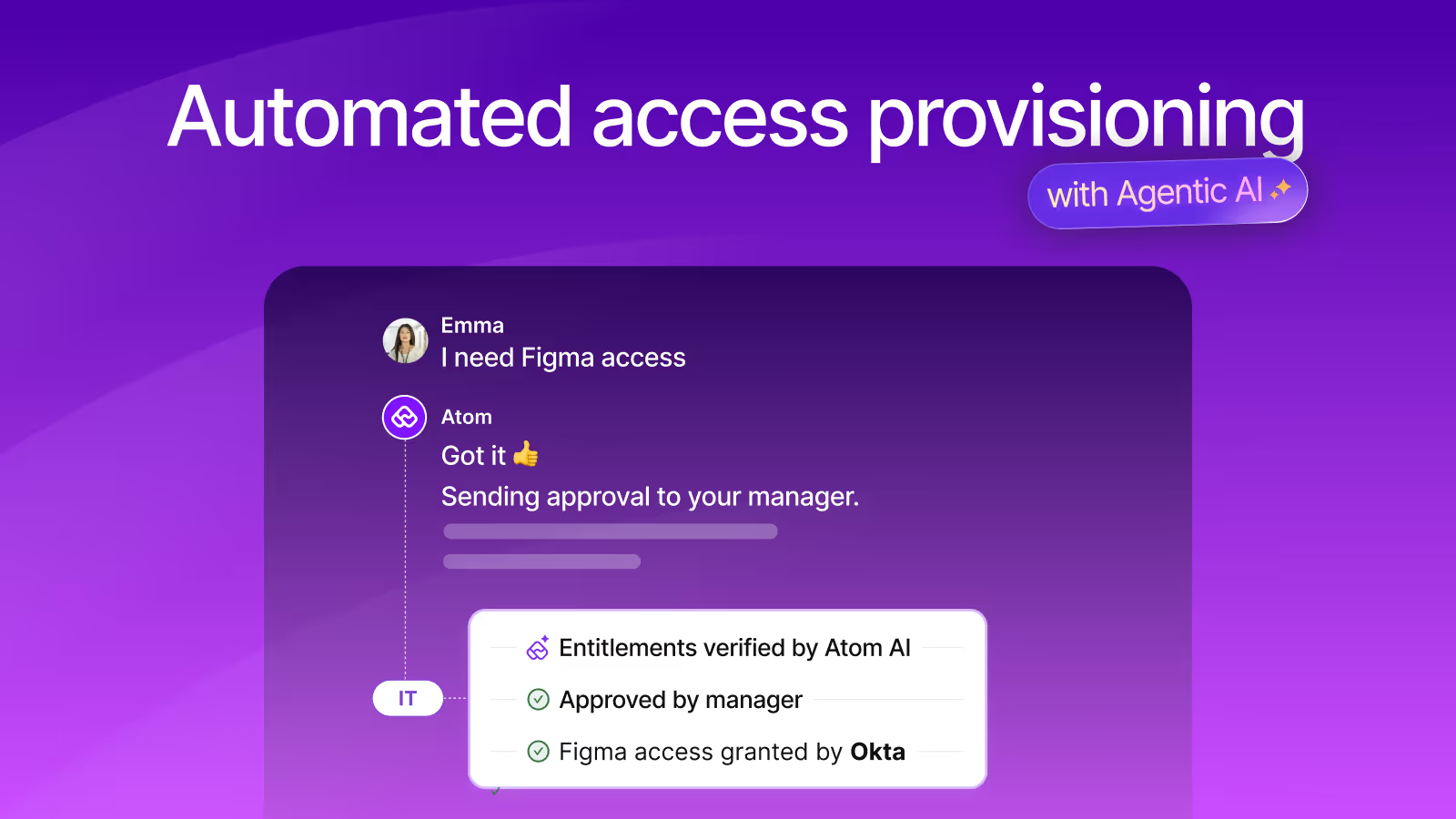
Now, when an employee raises a request through Atom in Microsoft Teams, they fill in a service item form, the request routes to an approver — also in Teams — and once approved, the action executes automatically. The ticket resolves on its own. No one logs into a separate portal. No one opens a console. So far, the team has automated shared mailbox access, mailbox forwarding, job title and department changes, and more — requests that used to take anywhere from 2 to 15 minutes of manual work now resolved with a single tap on a phone.
Watch Rinno walk through how the team has practically built these automations in the webinar "Zero-Touch Automations with Atomicwork."
Every one of these automated actions is tied back to a request in Atomicwork. That matters for compliance — Ammex is audited by banks annually, and auditors need to see proof that access was granted, permissions were changed, or licenses were provisioned through a documented request. Having every automation tied to a request means there's always an audit trail.
"When it comes to IT service experience, leveraging AI is probably one of the safer places to begin,” Steven says.“Baseline your current service desk experience and really understand your employees' satisfaction. Then rather than incrementally improve, look to completely reimagine with an AI lens to transform to the next level. Start inside your business where you can get wins quickly and where iteration and making mistakes are more easily tolerated."
"People are typically resistant to moving away from a behemoth like ServiceNow. Don't be afraid of change. Everyone these days is looking forward to using AI to improve their productivity, to reduce the amount of time it takes for them to do their job. Just embrace it."

One process stood out above the rest: offboarding.
Ammex'soffboarding process involves more than 30 high-level tasks including recovering assets,and closing out accounts. A third must be completed in the first 15 minutes, and the rest within a couple of days at most.
Before Atomicwork, most of these tasks were entirely manual, and the entire process took anywhere from 30 minutes to over an hour. While planned departures give the team time to prepare, unplanned terminations are where the stakes are highest.
In Atomicwork, once an offboarding request is filed, it immediately routes to IT for approval. Once approved, the workflow executes almost a half of the steps automatically — the critical first-15-minutes tasks: changing the password, removing user sessions, disabling the account, removing group memberships, clearing user/org fields which feed other automations, and converting the user mailbox to a shared mailbox.
All of that in about five minutes. No manual effort beyond the approval, giving the team back up to an hour.
Not just IT: Service management across the org
Atomicwork at Ammex isn't just an ITSM tool — it's an ESM platform used by departments across the company.
"If you need a shipping label, you go to logistics — that's done by Atomicwork. You need a credit memo, you file a ticket to finance — also Atomicwork."
The native Microsoft Teams integration means that approvals, notifications, and requests all happen in the same place where employees already spend their day. For service teams, all the context is in one place. And for the business, there's a single system of record.
And as more teams onboarded onto Atomicwork, something else has followed — a growing appetite for automation from outside IT. "You talk to other departments and they get an aha moment: ‘Really? That thing can be automated? I used to spend half my day doing just that.’”, Rinno describes. To sustain that momentum, AMMEX is appointing AI champions in every department — executive-level owners responsible for identifying what can be automated within their own teams.
The impact shows up in multiple ways. Resolution times on automated tickets are near-instant. The help desk isn't pulled away from complex projects for two-minute tasks. The offboarding process — once a source of stress and security risk — now runs in minutes with a single approval.
The move has also been significantly more cost-effective than their previous setup with Jira Service Management.
While the implementation has been successful and the team is delighted with Atomicwork, Rinno acknowledges that they are just scratching the surface of Atomicwork's potential. Features such as asset management, which could potentially allow remote actions like rebooting machines promise to further streamline operations and reduce reliance on multiple products.
For teams looking to start a similar journey, Rinno's advice is practical: appoint AI champions in every department so automation isn't just an IT initiative. Involve the people who'll actually use the automation in its design, so you build something that gets adopted. And start with your ticket data — go through your requests, find what's repetitive, and identify what gives back the most time.
What started as a search for a better ticketing system has become a company-wide shift in how work gets done. Requests that once pulled people away from their day now resolve themselves. Processes that once depended on a single person being at their desk now run with a single tap. And the list of what's next keeps growing — because at AMMEX, automation isn't an IT project anymore. It's how the company operates.
Ammex Corp's modernisation of their service management solution highlights the transformative potential of Atomicwork’s modern ITSM solution. By simplifying workflows, enhancing efficiency, and reducing costs, Atomicwork is enabling Ammex Corp to focus on what they do best—manufacturing and distributing high-quality safety gloves—while leaving the complexities and effort of service management to AI.
As Rinno puts it, Atomicwork has essentially extended their team, providing the support and tools needed to thrive in a modern, fast-paced business environment.




.avif)