The human side of AI-first IT leadership: Scaling AI without losing trust, judgment, or purpose

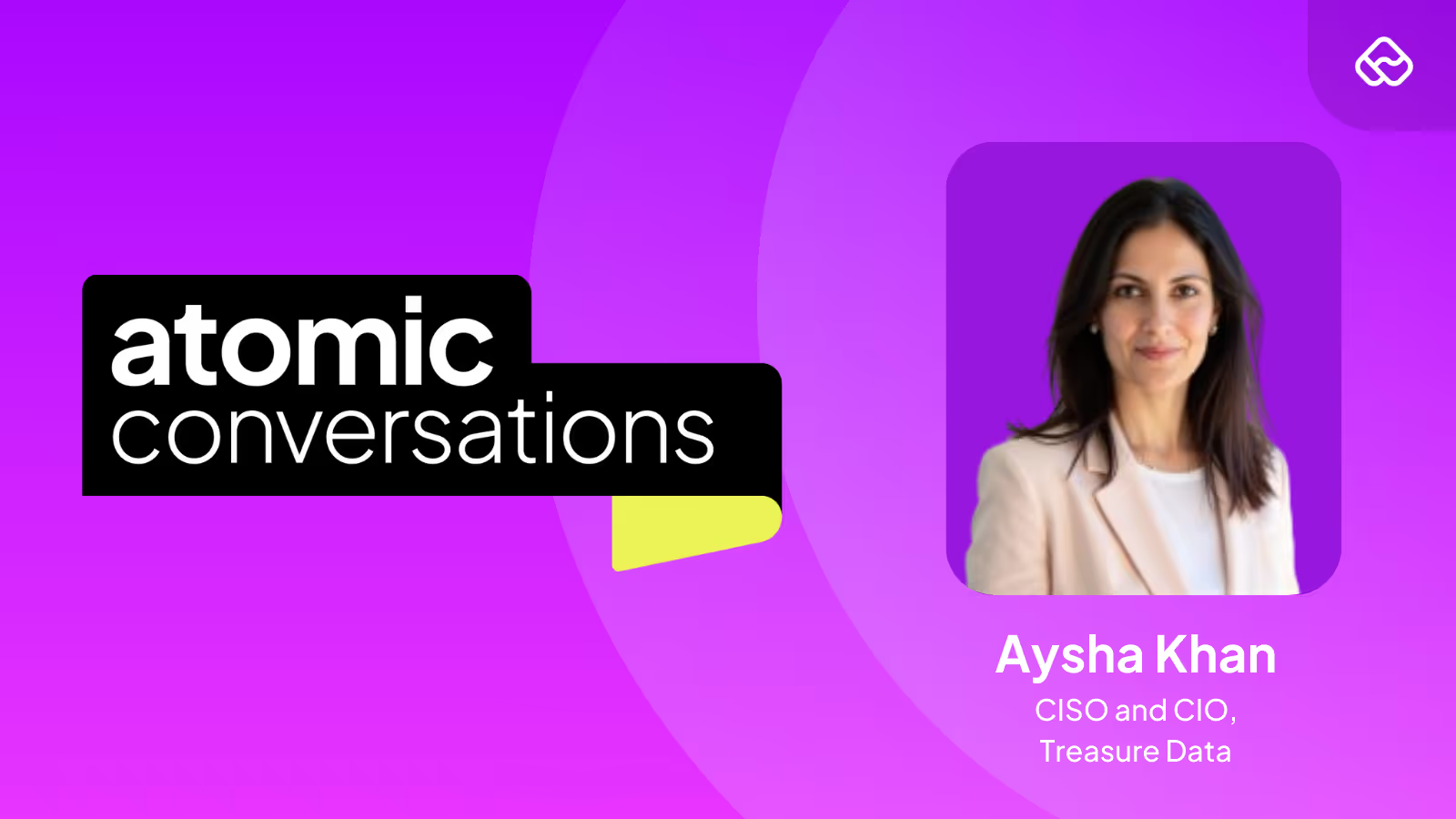
When Aysha Khan first joined Treasure Data as CISO in 2019, she couldn’t have predicted she’d be running IT three months later. Or that six years later, she’d be leading an organization that has identified 160 AI use cases and automated 60% of security operations.
In this episode of Atomic Conversations, we reconnected with Aysha Khan, CIO and CISO at Treasure Data, to explore how her thinking has evolved, from managing the dual role to building a genuinely AI-first organization while preserving the humanity that makes teams thrive.
Security is a business problem, not a technology problem
Aysha’s dual role has sharpened how she frames security to leadership. Rather than leading with technical complexity, she treats security as fundamentally a business conversation.
Security is not a technology problem; it is a business problem. Using that lens helps me articulate risk to senior management and align technology objectives with business objectives. - Aysha Khan, CIO and CISO of Treasure Data
This reframing has transformed how she communicates with the C-suite, particularly her CFO.
“My relationship with my CFO is amazing because we talk about evidence and business outcomes. I articulate risks in numbers to justify the investments needed based on our risk tolerance.”
When security leaders complain about not getting budget, Aysha puts the onus back on them: Have you translated the technical risk into business terms that the CFO can act on?
AI won’t take your job, but a person with AI will
Aysha doesn’t sugarcoat the AI reality with her teams. Her message is direct: “AI will not take your job; a person with AI will definitely take your job.”
But she’s not using fear as motivation. Instead, she made AI available to everyone at Treasure Data, treating it as an amplifier rather than a replacement. The result is that employees who once handled routine tasks are now moving up to strategic work that had been sitting in the backlog for years.
As AI takes over the ‘busy work,’ my people can move up the food chain to do strategic thinking on projects that have sat in our parking lot for years.
What struck me most was how Treasure Data operationalized AI adoption. Rather than letting IT drive everything, Aysha assembled “business translators”, people from marketing, sales, and accounting who understand their domains’ pain points and can identify meaningful use cases.
She also launched an AI champion program, training two representatives from every business unit who then cascade that knowledge to their teams. In just 18 months, this approach surfaced 160 potential use cases.
Aysha is also candid about where AI agent technology actually stands today. Despite the marketing hype, she’s still waiting for agents that deliver on their promise.
“Those are not agents, those are prompts. I'm still waiting for agents who can mimic humans: real reasoning, repeatability, explainability, and auditability. Those are the autonomous agents I’m talking about. We haven’t seen them yet.”
Her prediction is that it’ll take six months to a year before clear winners emerge.
Secure innovation over security as a stick
One challenge with dual CIO/CISO roles is balancing enablement with protection. Aysha’s philosophy: lead with “secure innovation” rather than wielding security as a blocker.
She mentions how at Treasure Data they focus on ‘secure innovation’ rather than using security as a stick. They even incentivize their engineers to code securely and IT/security team to enable the business.
The incentives are deliberately reversed: engineers are measured on security quality, while IT and security teams are measured on business enablement. This creates natural collaboration rather than friction.
She also established a risk committee involving the CTO and CLO, ensuring that high-stakes decisions aren’t made unilaterally. When evaluating AI initiatives, the committee assesses value, readiness, and adoption, including training teams on the new threat landscape that AI introduces.
As AI agents proliferate across organizations, Aysha sees governance as the critical next frontier. The fundamentals still apply: data governance, access controls, and auditability to track what actions agents take.
But governance isn’t just theory at Treasure Data; they’re already seeing what’s possible when agents are deployed thoughtfully. The impact on security operations has been significant. By deploying an AI agent for L1 and L2 tickets, Aysha’s team automated 60% of their security workload. This fundamentally changed the quality of life for her team.
That same employee who had to wake up in the middle of the night addressing things—this person now doesn’t have to do any level one, level two. We are moving him up the food chain to level three. The schedule is getting better.
The inner work of leadership
Our conversation took an unexpected turn when Lenin asked about her leadership style. Aysha traced her approach back to a personal transformation that began a decade ago, what she calls the journey from “inward to upward.”
“Your leadership is directly proportional to the inner work you have done.”
When asked her to describe herself in six words, she said: “Living intentionally, passionately, fearlessly every day.” That fearlessness, she explained, came from getting clear on what truly matters.
Perhaps the most actionable insight for leaders was Aysha’s hiring philosophy. Technical skills are table stakes, she expects high IQ. But EQ determines success.
High emotional intelligence, she explained, brings the “calm clarity that amplifies everything we do.”
Aysha also went on to admit that perfectionism once made her a bottleneck. The shift came when she learned to trust and delegate, which paradoxically increased both speed and trust across her organization.
What resonated most from this conversation was Aysha’s integration of seemingly opposing forces: security and innovation, AI and humanity, professional ambition and personal purpose.
AI is giving us time back, she believes. The question is what we do with it.
If you enjoyed skimming through the highlights, you can watch the entire conversation here.