15 Modern ServiceNow alternatives to evaluate in 2026

“You can’t get fired for buying ServiceNow.”
— Ancient IT proverb
That logic held for years. In 2026, it’s exactly what IT teams are questioning.
ServiceNow is still powerful but power now comes with trade-offs. Following the Moveworks acquisition, many teams expected faster, more autonomous support. Instead, for many IT orgs, the day-to-day still looks familiar: heavy configuration, rising overhead, and “AI” that often stops at triage.
That’s why the pushback has become louder in practitioner circles too. In one widely-upvoted Reddit thread, admins describe ServiceNow as a “parasitic dinosaur” not because it can’t work, but because when it’s treated as “just a ticketing system,” it can feel overpriced, under-loved, and dependent on dedicated owners to stay usable.

This is where agentic ITSM changes the conversation. Unlike chatbot-led ITSM, agentic platforms use AI agents that understand context, take actions across systems, and resolve issues end-to-end without routing everything through tickets or portals.
That’s why 2026 looks less like “playing it safe” and more like rethinking ITSM from the ground up.
Why look for ServiceNow alternatives?
You’re right. ServiceNow is a comprehensive and highly customizable service management solution that covers a wide range of use cases. On paper, it’s the safe choice.
But it’s a safe choice for large enterprises with big budgets and enough time for implementation and customization. Not to mention, access to dev resources or additional budget to hire ServiceNow certified consultants for implementation and ongoing customizations.
Not every business requires (or has the capability to utilize) such an extensive platform or can expect a positive return on the investment.
For nearly two decades, ITSM remained largely unchanged. However, we are now at the cusp of another paradigm shift - the agentic AI movement. While AI has been around for a while, GenAI and agentic AI are now being adopted widely to eliminate process overhead for end-users and IT teams.
Legacy vendors are bolting AI on top of their existing platforms causing both the platform and the cost to bloat up. That's why new solutions are emerging with AI at the core.
This blog will look at such modern alternatives to ServiceNow that support the service management needs for organizations of different sizes.
What should IT leaders prioritize when choosing a ServiceNow alternative in 2026?
While looking for an alternative to legacy players like ServiceNow, IT leaders need to consider if it's:
1. AI-native vs. AI-bolted
Don’t just ask “Does it have AI?” Ask where AI lives in the architecture. AI-native platforms are built for automated resolution and orchestration; bolted-on AI typically stops at summarization, routing, or chatbot deflection.
2. Context aware (apps, identity, role, device)
Modern service delivery should adapt to the employee: who they are, what tools they use, and what they’re trying to do, not force them into forms and portals.
3. Total cost of ownership is low (licenses + consultants + ops)
Look beyond subscription pricing. Evaluate the real cost of administration, customization, integrations, and ongoing platform ownership.
4. Employee experience focused (flow-of-work vs. portal-first)
The best alternatives support employees where work happens—Slack, Teams, email, browser—so support feels instant, not like filing a ticket.
5. Time-to-value is fast (weeks vs. quarters)
Prioritize tools that can go live quickly without an army of consultants. Implementation speed matters because it directly impacts adoption, cost, and how quickly you can prove ROI.
Here are the top ServiceNow alternatives at a glimpse.
1. Atomicwork
Atomicwork is an agentic ITSM solution that delivers core IT and ESM through agentic AI that adapts dynamically to employees, roles, and business functions.
The Atomicwork platform seamlessly integrates with enterprise applications across IT, DevOps, HR, finance, and workplace support teams to deliver context-aware, proactive support, and service management automation on email, browser, collaboration tools like Slack and MS Teams.
With our AI-based approach to service management, organizations can significantly reduce response times, deliver real-time help, and automate core IT processes effortlessly. Apart from automating routine tasks such as password resets and access provisioning, Atomicwork enhances the service desk experience by streamlining request handling, incident management, problem, change, and asset management in one unified platform.
Switching from ServiceNow, Ryder Hampton, Head of Technology at Australia's leading financial technology at PepperMoney, highlights how Atomicwork transformed their global IT operations.
We were able to deploy this new platform and replace a number of incumbent solutions within 6 weeks. We have already seen significant improvements across ticket deflection, self service and most importantly employee experience. Moving across to the Atomicwork solution also reduced our TCO by consolidating 3 different solutions into one platform. Ryder Hampton, Head of Technology at PepperMoney.
Compare how Atomicwork stacks up against ServiceNow in detail here.
2. Jira Service Management
Jira Service Management, with its built-in AI engine, leverages natural language processing and GenAI to enhance IT service management. This automates tier 1 repetitive support issues, thereby accelerating problem resolution and reducing ticket volume.
You can create custom intents or even use the knowledge base to automate tier 1 support workflows. IT support agents can now tackle complex issues that need their expertise. If you’re using the Atlassian suite with Jira, Confluence, etc, getting Jira Service Management would work like a natural extension to your current ecosystem.

3. EasyVista
EasyVista leverages AI to deliver features like automated workflows and intelligent knowledge management, which help streamline service processes and improve efficiency.
EasyVista's acquisition of Coservit, which delivers an AIOps and next-generation monitoring software technology, ServiceNav, enhances its capability with predictive analytics and monitoring, providing a more proactive service management approach.

4. Freshservice
Freshservice offers an AI suite called Freddy to streamline IT service management and boosts employee and IT productivity. It includes a self service solution, a copilot, and provides insights.
The AI-driven virtual agent provides immediate conversational support and efficiently handles incidents and service requests. It enhances agent productivity by automating responses and standardizing service delivery.

5. InvGate
InvGate Service Desk features AI-driven capabilities such as automation of workflows and AI-powered features that suggest ticket recategorization and automate ticket responses, enhancing the efficiency of service operations. Along with its integration capabilities, it can be used for various business workflows.

6. Ivanti
Ivanti Neurons for ITSM leverages AI to streamline operations and improve service delivery across IT environments. Some of its features include intelligent automation for routine tasks, predictive analytics to prevent service disruptions, and advanced knowledge management capabilities that help gather, share, and manage critical information efficiently.

7. Solarwinds
SolarWinds Service Desk incorporates AI and ML technologies to improve efficiency and user experience. These include an AI-powered virtual agent that assists users with common IT issues, allowing IT staff to focus on more complex tasks.
The system also offers AI-generated responses that save time for agents and AI-generated incident summaries that improve collaboration by providing concise overviews of communication threads.

8. HaloITSM
HaloITSM incorporates AI to automate and enhance service delivery. Key AI functionalities in HaloITSM include automated ticket assignment, knowledge base article suggestions, and predictive capabilities to anticipate potential issues before they occur.
This AI integration helps streamline processes, improving agent productivity, and enhancing the overall user experience by enabling more efficient and error-free service management.

9. TOPdesk
TOPdesk incorporates AI capabilities to streamline service operations and improve user experiences through automation and integrated AI functionalities.
These AI-driven features include automated incident management, where incidents are intelligently categorized and routed to the appropriate agents based on the ticket’s content. Furthermore, TOPdesk leverages conversational AI through chatbots to assist users via self-service portals.

10. SysAid
SysAid offers an AI-first IT approach that seamlessly integrates with its service desk capabilities.
SysAid's comprehensive solution includes inventory management, remote control capabilities, software management, network discovery, patch management, and deep service desk integration. Their upcoming AI Agents for Asset Management promises to further streamline IT operations by automating tasks like extracting asset details, generating warranty expiration reports, and managing routine maintenance.

11. Zendesk for IT
Zendesk for IT applies the company's customer service expertise to internal IT service management, offering an AI-powered solution that simplifies employee service across the organization. The platform can be deployed quickly and integrates with popular workplace apps like Slack and Microsoft Teams, meeting employees where they already work.
Zendesk's AI capabilities help IT teams triage requests and automate workflows, enabling faster case resolution with fewer resources. The platform provides comprehensive visibility into all service interactions with automatic ticket scoring, helping teams continuously identify service gaps and improve quality.

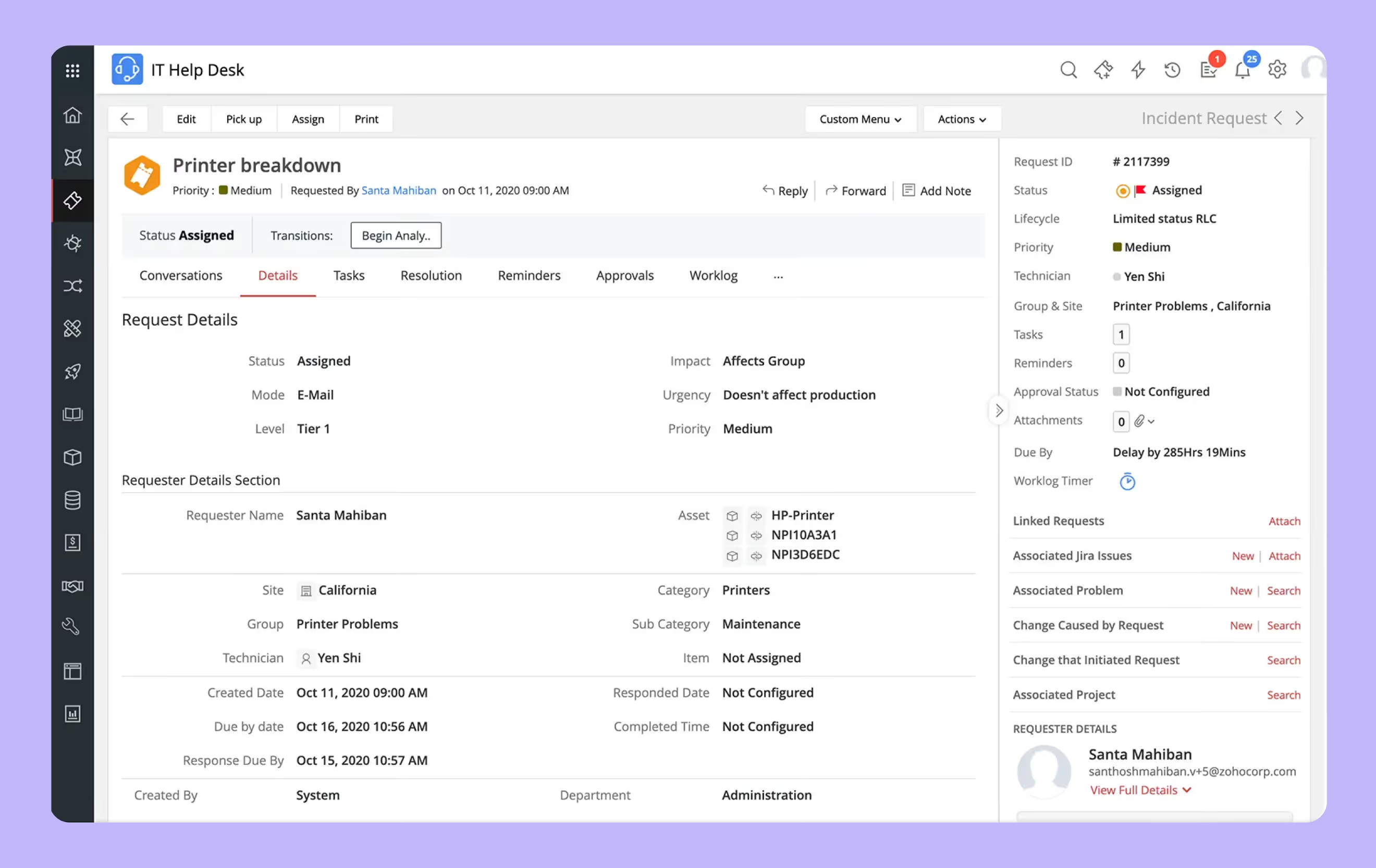
12. ManageEngine ServiceDesk Plus
ManageEngine ServiceDesk Plus is a traditional ITSM platform widely adopted by mid-market and cost-conscious enterprises. It offers core ITIL-aligned capabilities such as incident, request, change, and asset management, with deployment options across cloud and on-premise environments.
In recent years, ManageEngine has introduced Zia AI to assist with ticket categorization, response suggestions, and basic automation. While these capabilities improve operational efficiency, the platform remains workflow-centric, with AI largely supporting human-driven processes rather than acting autonomously.
ServiceDesk Plus is often evaluated by teams looking for a lower-cost alternative to ServiceNow without the complexity of large-scale enterprise platforms. However, organizations seeking end-to-end resolution, contextual reasoning, or agent-driven automation may find its AI capabilities incremental rather than transformative.
13. BMC Helix ITSM
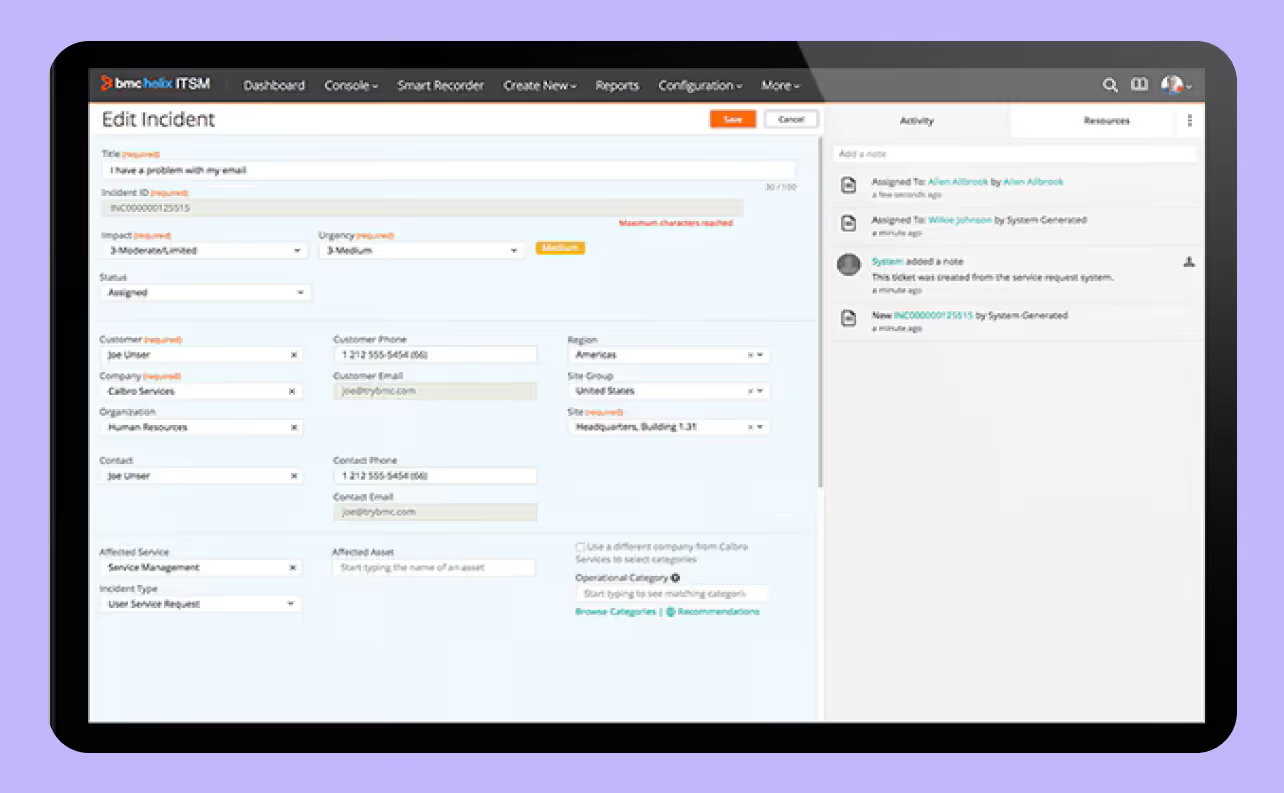
BMC Helix ITSM is one of ServiceNow’s closest legacy counterparts, built for large enterprises with complex, global IT environments. It delivers a comprehensive suite covering incident, change, asset, and service management, backed by deep ITIL process support.
BMC’s recent push around HelixGPT reflects the broader industry shift toward AI-powered ITSM, with features focused on summarization, recommendations, and guided resolution. However, Helix remains fundamentally an AI-enhanced legacy platform, where AI augments existing workflows rather than replacing them.
BMC Helix is most relevant for organizations modernizing from older BMC or Remedy stacks and looking to introduce AI without re-architecting their service model. For IT leaders aiming to move beyond ticket-centric operations toward agentic service management, Helix represents an evolutionary step—not a clean break from legacy ITSM.
14. Atera
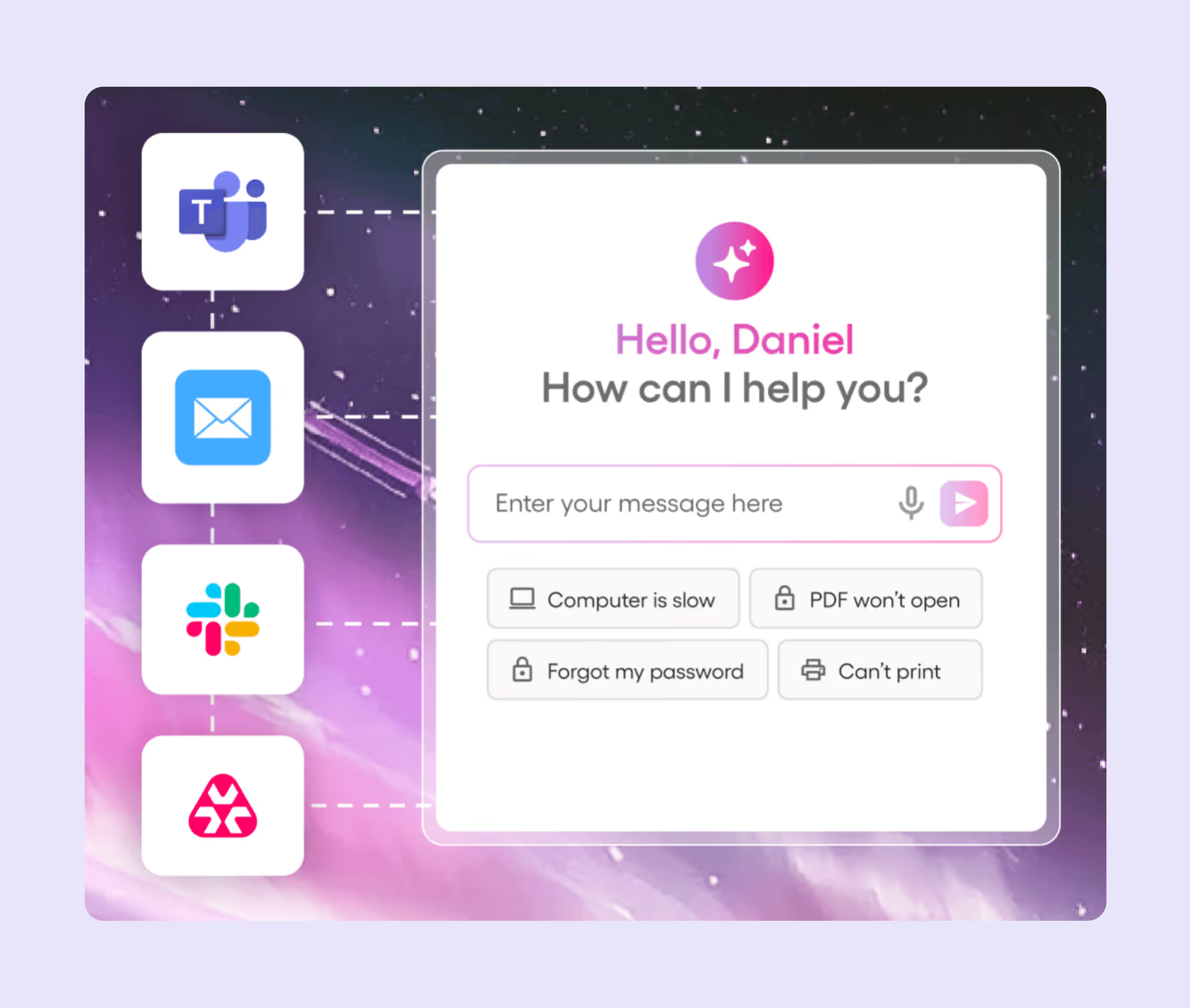
Atera is an IT management platform for managed service providers (MSPs) and small to mid-sized IT teams that need streamlined remote monitoring and management (RMM) with integrated service desk capabilities. It unifies network and endpoint monitoring, patch management, ticketing, scripting automation, and billing into a single interface.
Atera is well-suited for IT leaders and MSPs seeking a cost-effective, unified toolset that reduces tool sprawl and simplifies operations. For organizations exploring AI-first or agentic ITSM approaches, Atera represents a modern, integrated RMM-plus-service-desk option that emphasizes operational efficiency over autonomous AI-driven service orchestration.
15. TeamDynamix
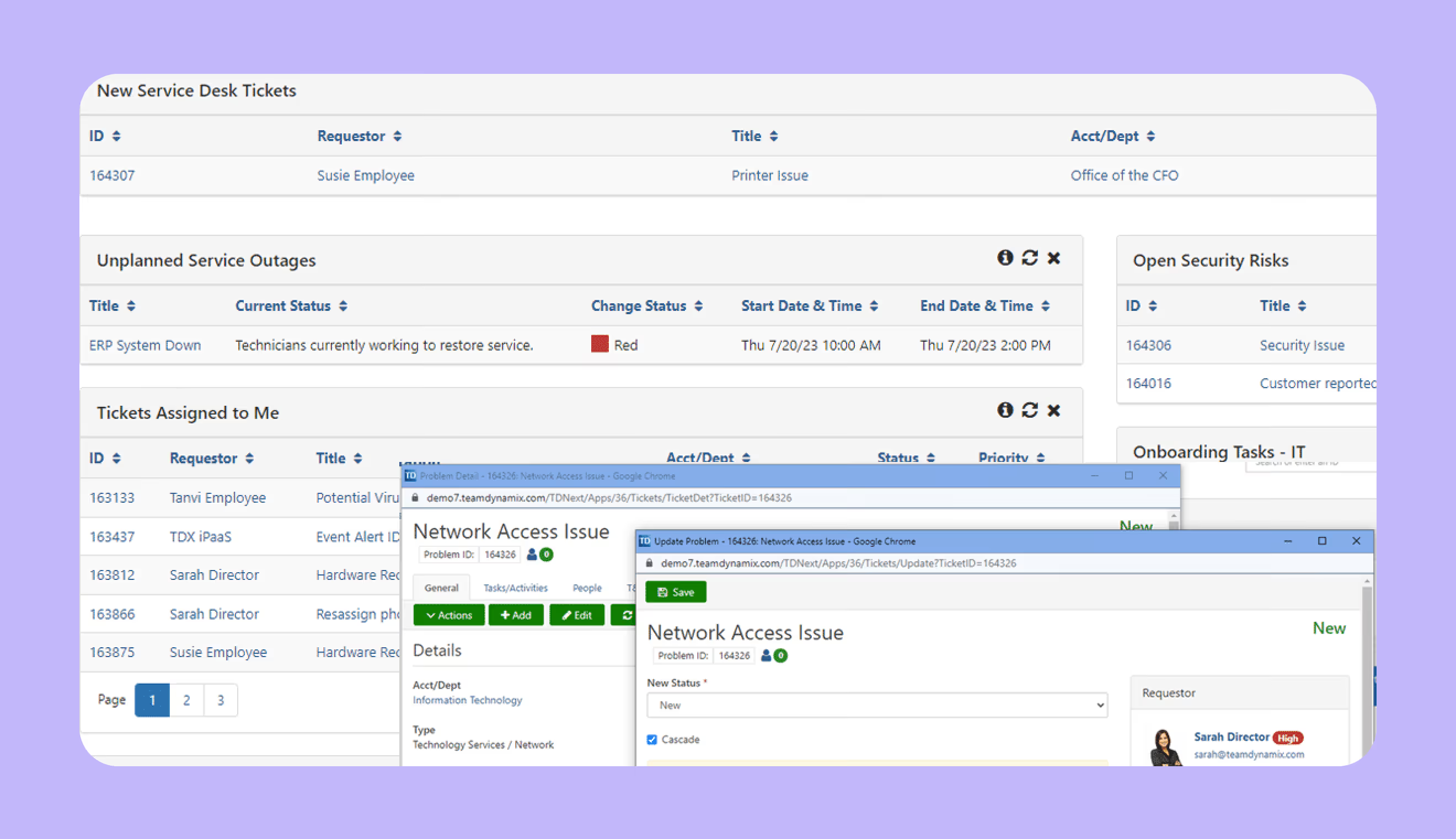
TeamDynamix is a service management and project portfolio management platform widely adopted in higher education, healthcare, and mid-market enterprises. It provides structured ITIL-based service management along with workflow automation and integration capabilities.
The platform emphasizes usability and governance, offering configurable service catalogs, ticketing workflows, and reporting dashboards. While it supports automation and AI-assisted features, its core architecture remains centered around structured processes and ticket-driven service delivery.
TeamDynamix is well-suited for organizations seeking a modern interface and strong process control without the scale or complexity of large enterprise ITSM suites. For IT leaders exploring AI-native or agentic platforms, it represents a modernized—but still workflow-led—alternative.
In conclusion
As we enter the AI era of ITSM, it's crucial to reassess your organization's needs and explore alternatives, if necessary. When evaluating options, consider your budget, resources, and readiness for AI-driven innovation. The right choice could significantly enhance your IT and business operations, positioning your organization for success in this rapidly evolving tech landscape.
Disclaimer: We, at Atomicwork, have built ITSM solutions in the past and understand the challenges that IT leaders and organizations grapple with. With the immense power that AI offers, we were able to build a modern service management solution for 2025 and beyond.
If you’d like a walkthrough of the platform, sign up for a demo.


Frequently asked questions