Meet the Atomicwork AI Workforce

.avif)
"AI agent" has become a label that fits almost anything. A chatbot that answers FAQs is an agent. A workflow with an LLM in one of its steps is an agent. A script that calls a tool is an agent. The category has stretched so wide that it has stopped meaning much.
The teams we work with are past this conversation. They have agents. They have copilots. They have AI features bolted onto every tool in their stack. What they don't have is someone who actually owns a role - an L1 dispatcher who runs the queue, an onboarding coordinator who sees a new hire through their first week, a hardware specialist who picks up the ticket about the slow laptop and stays with it until the user is unblocked.
When you hire a person for one of these roles, you don't hand them a task list. You give them a job description, a team, a manager, the systems they need to do the work, a budget, and a way to be evaluated. They show up, take ownership of an outcome, ask for help when they need it, and get better over time. That is the unit of operation that enterprises are actually built on.
For the last three years, almost everything sold as "enterprise AI" has been a faster version of a task. Generate this email. Summarize this ticket. Classify this request. These features are useful. They are also one layer below the thing teams are actually trying to solve for. You can have all the AI tools in the world and still have an understaffed L2 queue.
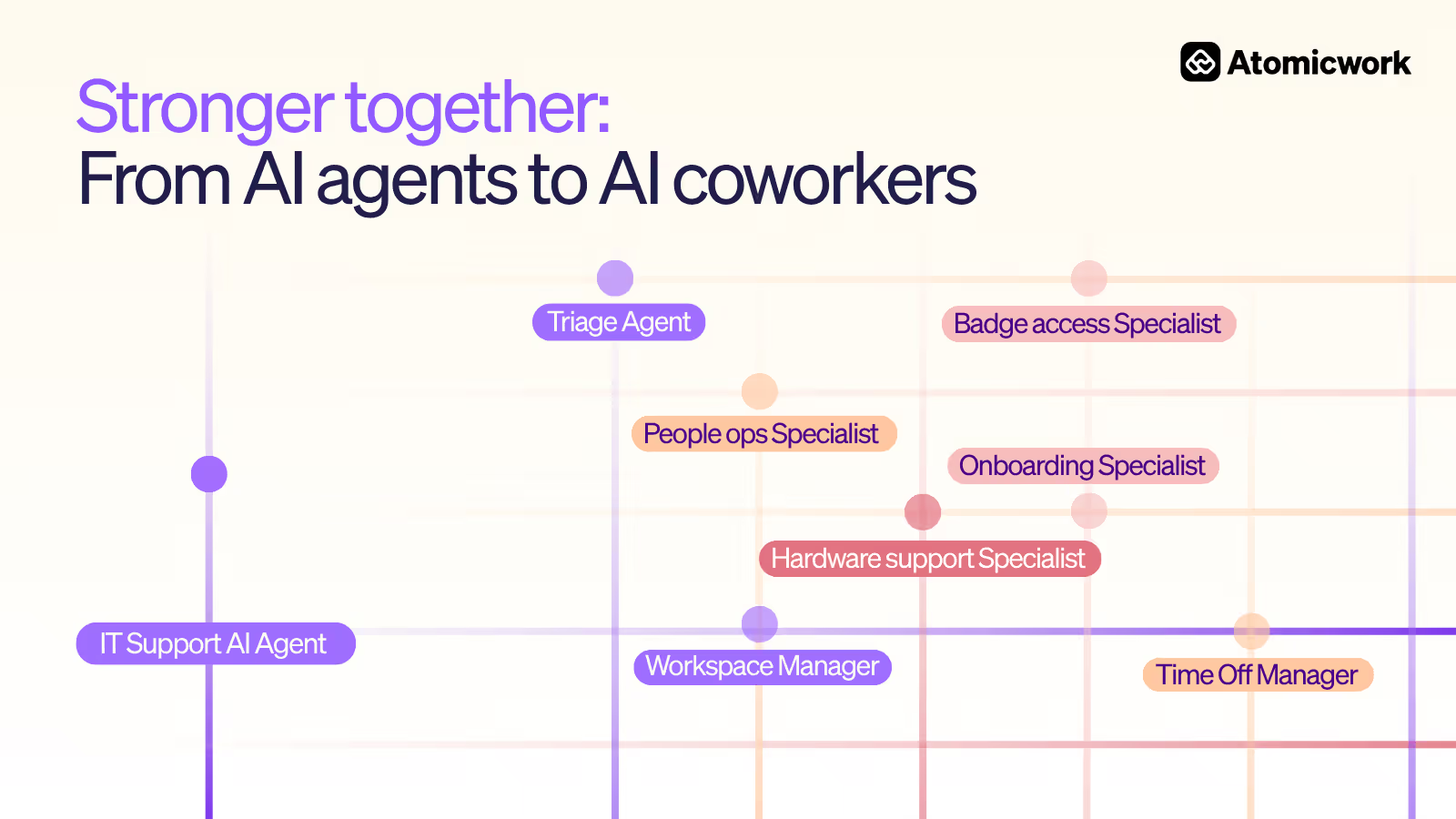
The AI Workforce is the layer above. An AI Coworker has a name. It owns an outcome end to end. It has the tools, the access, the budget, and the manager you'd give a human doing the same job. When you describe what it does, you describe a job, not a task.
Today we are launching the Atomicwork AI Workforce - a set of AI Coworkers built around that idea. Each one ships with a defined scope, a set of skills, a budget, and a human manager. The rest of this post is who they are, how managing them looks the same as managing the humans they sit next to, and why this all became possible now.
Meet the team
Seven AI Coworkers ship in the launch lineup. Each one owns a defined slice of service work end to end, with a human manager in the workspace they belong to.
- Device Ops Engineer. Handles hardware-related support tickets including device failures, peripheral issues, firmware problems, and MDM-managed device diagnostics.
- Network Ops Engineer. Diagnoses and resolves network connectivity issues including VPN failures, DNS misconfigurations, firewall rule anomalies, and LAN/WAN disruptions.
- Cloud Ops Engineer. Monitors and manages cloud infrastructure including compute, storage, networking, and Kubernetes clusters.
- Access Manager. Manages application access requests, provisioning, and de-provisioning across SaaS and internal applications.
- Incident Manager. Monitors and responds to incidents involving third-party SaaS applications used by the organization.
- SecOps Engineer. Responds to phishing reports and coordinates containment with the employee.
- HR Ops Specialist. Supports employees through everyday HR requests including onboarding, policy questions, benefits queries, leave support, employee documentation, and routine HR service needs.
AI Coworkers also hand off to each other the way humans do; the Device Ops Engineer pulls in the Network Ops Engineer when a device looks healthy but isn't connecting, the Incident Manager pulls in the Access Manager when a sign-in failure correlates with application access.
This is the launch lineup, not your final agentic org chart. You can create AI Coworkers to own any service functions in your org – Legal Ops, HR Ops, Onboarding and so on.
AI Coworkers vs. human agents: same operating model
Every dimension your org already uses to manage humans applies to the Atomicwork AI workforce. Same primitives, same controls, same accountability.
- Identity. A human agent has a name, an email, an employee ID. An AI Coworker has a name, a service account, an agent ID.
- Job role. Humans get a job description, a team, a manager. Coworkers get job goals, a team, a manager. The artifact changes, the structure doesn't.
- Lifecycle. Hire, onboard, offboard for humans. Configure, deploy, deprovision for Ccoworkers. You stand a Coworker up the way you onboard a new hire.
- Skills. Humans build skill through training, certifications, and mentorship. Coworkers build skill through tools, knowledge, and fine-tuning. A new Coworker learns your runbook the same way a new hire would.
- Access control. SSO, RBAC, least privilege - identical for both. The day you treat Ccoworker access differently from human access is the day you have a governance problem.
- Performance. Humans get KPIs, reviews, coaching. Coworkers get evals and feedback loops. The data is already in the system, so the review cycle can run weekly instead of annually.
- Budget. Humans operate inside spend caps and expense policies. Coworkers operate inside token budgets and tool-call limits. Every worker has a cost envelope and a manager who owns staying inside it.
If you can manage people, you can manage an AI workforce. The operating model is the same one your organization has run on for decades.
What made this possible now
AI Coworkers are not a new idea. What was missing were a few core technology pieces underneath - four of them, specifically, and all four have landed in the last few months.
- Agent harness. An AI model on its own has no memory, no goals, and no guardrails. The agent harness is what turns a model into an entity - role-specific goals, scoped permissions, persistent memory, tools, and the guardrails that prevent it from doing something it shouldn't. A year ago, building this from scratch was the work. Now the patterns have stabilized enough that you can configure a Coworker the way you'd configure an Okta group.
- Sandboxed execution. Giving an agent real access to enterprise systems continues to be a challenge. You either trust the agent with broad credentials, which no security team would sign off on, or you constrain it so heavily that it can't actually do the job. Sandboxed execution changes that math. Coworkers now run in controlled, isolated environments where their actions are observable, reversible, and bounded.
- Pluggable skills. A skill used to be something you built into a specific agent on a specific platform. If you wanted the same capability somewhere else, you rebuilt it. The shift to portable, vendor-neutral skill formats means a capability is now something you write once and share across agents, teams, and platforms. Skills become a marketplace.
- Enterprise tools. None of the above matters if your Coworkers can't reach the systems where work actually happens. The standardization around MCP servers has solved the last-mile problem in a way that point integrations never did. A Coworker can now talk to JumpCloud, Entra ID, Workday, Okta, Salesforce, your ticketing system, and the long tail of internal tools through a single, consistent interface.
Each of these existed in pieces a year ago. None were quite ready. What's different now is that all four are ready at the same time, and they compose. The harness gives a Coworker a body. Sandboxed execution gives it a safe place to act. Skills give it capabilities. Enterprise tools give it reach.
What this means
The IT teams we've spent the last year working with are at an inflection point. The previous decade was about building workflows. The next era is about deploying and managing a workforce that runs on top of them.
The Coworkers shipping today are the ones we and our customers have been running in production. They're the start of the team you'll be managing for the next decade.
Don't build AI workflows. Deploy the AI workforce.
If you want to see what your first AI Coworker would look like, we'd love to show you.