A CIO's Journey Through 30 years of Tech Transformation ft. Venky Rangachari
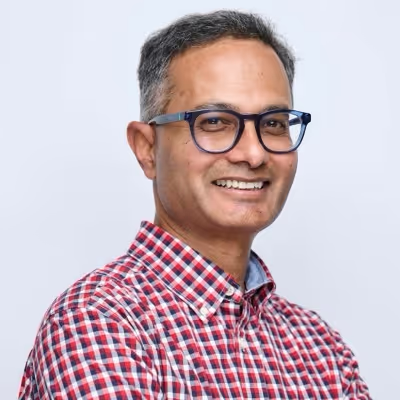
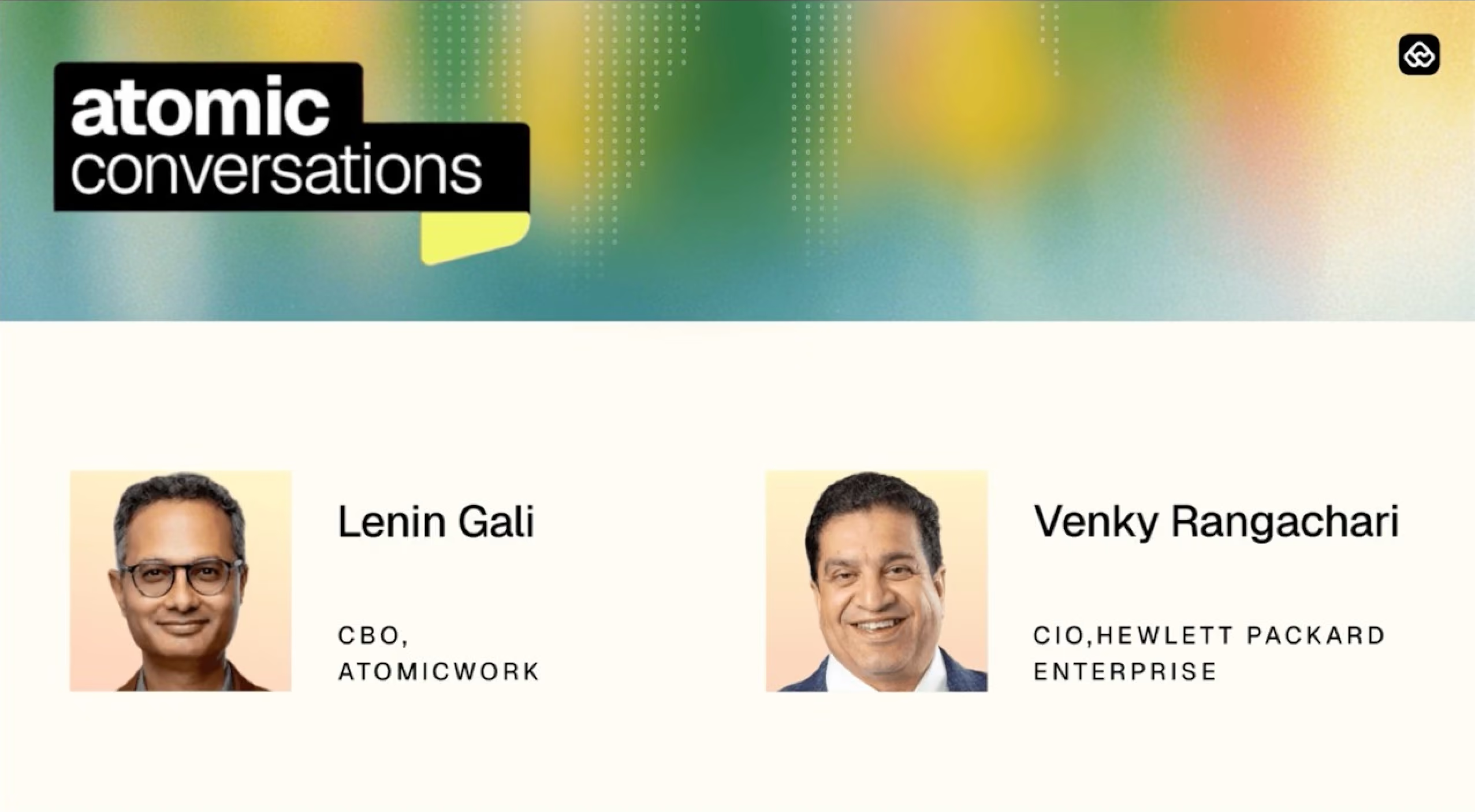
I sat down with Venky on short notice and he showed up with thirty years of stories ready to tell. Venky is one of those rare technologists who has been at the front of every major wave: the internet, the data center era, SaaS, cloud, and now AI. He’s currently a CIO at HPE, and his career reads like a map of Silicon Valley’s history. What struck me most wasn’t just what he’s seen, it’s how clearly he sees what’s coming.
Here’s that conversation, lightly edited for clarity.
Growing up in Chennai: Where it all started
Lenin: Take me back to the beginning. Where did the fascination with computers start?
Venky: I grew up in Chennai, in Tamil Nadu. My fascination with computers started in high school — we were actually the first tenth grade batch to have computer science as an elective. We were mesmerized just sitting in front of a terminal, typing in commands, doing basic programming. There was also a very practical reason: Chennai is really hot, and the computer room was air-conditioned. So we spent a lot of time in there.
Venky: By the time I was done with school, I knew I wanted computer science. I did my undergrad in math and took computer science courses side by side at NIAT. Started with COBOL — you had to write a hundred lines of code to get the most basic thing done. But that’s where it all began.
Lenin: You had a choice between math research and software. What pushed you toward software?
Venky: Passion. My heart was with software, with building things. Even in college, I was doing part-time work for local entrepreneurs, helping them with their IT. I was the default “IT person” at home — always tinkering with gadgets, always curious about how things came together.
Venky: Right after college, before I got my first real job, I was interning at a company in Chennai that assembled PCs. You’d bring in all the parts — video cards, drives, everything — put them together, install the software, configure the whole system, and deliver it. I loved it. When the CD-ROM came along, we had to figure out how to fit it alongside the floppy drive and still make everything work. That problem-solving instinct — that’s still with me.
The leap to Silicon Valley
Lenin: You came to the US in the mid-90s. How did that happen?
Venky: I was visiting my sister in the Bay Area in December — which, as you know, is a lovely time to escape the Toronto winter I was working in. And I thought, why not just apply for a job while I’m here? In 1996, you faxed your resume. So I faxed it in, and I got a job as a Java programmer at Exodus. This was a tiny startup — maybe twenty, thirty people in Sunnyvale. I had been reading James Gosling’s book on Java, so I was excited. Very early days.
Lenin: Exodus became a landmark company. What was it like from the inside?
Venky: It was extraordinary. When I joined, Exodus was an ISP trying to figure out what to do with e-commerce — we even had CyberCash on the board. We were navigating everything in real time. Yahoo was a startup. Hotmail was a startup — they actually wanted to put kiosks in airlines to give free email to the world. Google was just getting started. AOL was still the biggest player. It was a very different landscape.
Venky: The internet access model back then was built on the telephone model — you assume not everyone’s on the phone at the same time. But the internet is the exact opposite. It’s twenty-four by seven. Search engines were crawling the web through the night, e-commerce companies were transacting all day. The math didn’t work.
Venky: We actually had a major search engine company move from UC Berkeley to Santa Clara in the middle of the night — walkie-talkies, storage arrays, those Sun E10K “refrigerator servers.” We called them that because they were enormous.
Lenin: And that led to Exodus inventing the Internet Data Center?
Venky: Exactly. Before Exodus, they were called “cages.” We came up with “Internet Data Center.” And we figured out private peering — instead of routing everything through public exchange points in San Ramon and Washington DC (which were the only two in the US, and Europe had to route through DC and back), we built the infrastructure for companies to peer directly with us.
Venky: The public peering point in DC was literally housed in a parking garage. When the elevators moved, you’d get voltage fluctuations. We had to reimagine the whole thing.
Venky: Once we did, we grew forty percent every quarter — four hundred percent a year. We went from three million dollars to a billion dollars in under four years. We were opening data centers that were sold out before they opened. That’s when the real networking era began: BGP routing, massive switches, the jump from ten megabits to fast Ethernet to, today, 1.6 terabits per second.
Venky: Oh — and in those early days at Exodus, we got power for free with the data center space. Then PG&E went bankrupt around ’99-2000, and suddenly we realized power was the real economic variable. Today if you walk into any data center company, the first question is: how many megawatts do you need? The economics flipped completely, and we didn’t see it coming at the time.
The internet era was a dress rehearsal for AI
Lenin: You’ve described the internet era as parallel to what’s happening with AI today. What’s the parallel you keep seeing?
Venky: When the internet first came, nobody really understood the model. ISPs were competing on access — sell bandwidth to homes and businesses. But the model was borrowed from telephony, and it was wrong. It took years to realize that and rebuild the infrastructure from scratch.
Venky: AI is in that same early-confusion phase. But here’s what I think is actually different this time: every wave before AI — client-server, the internet, SaaS, cloud — solved an economic problem. Why run your own data centers? Why run your own software? The model changed, the hosting changed, the user experience got better. But the underlying business processes? They stayed the same. Your CRM is still your CRM. Your ERP is still your ERP. Same problem, different era.
Venky: What agentic AI allows you to do is actually rethink the software ecosystem. You can have agents that solve specific business problems or automate entire processes, regardless of what underlying software is running or where the data lives. That layer gets abstracted away. That’s genuinely new.
The steam engine analogy: Re-architecting the enterprise
Lenin: You used a great analogy about steam engines to explain this.
Venky: Right. In the 1800s, factories were architected around steam engines. The engine sat in the basement, and everything — the belts, the shafts, the entire factory floor — was organized around proximity to that power source. Big machines near the shaft because they needed more power. Smaller machines farther away. Buildings were multi-story not because people liked high-rises, but because that was the most efficient layout for power distribution.
Venky: Then the electric motor came along. And it took decades — decades — to re-architect factories around it. But when they did, they asked: do we need all these floors? All these belts? And the answer was no. Every machine could have its own motor. The factory could be reorganized around the work, not around the power source.
Venky: That’s where we are with AI. The AI is the new motor. The question is: how do we re-architect the enterprise around it? What belts and shafts — what workflows — do we eliminate?
Lenin: Give me a concrete example of a workflow that needs to go.
Venky: The IT help desk ticket. Walk through what happens today: someone has a problem, they go to a portal, open a ticket, get an automated “thanks for your ticket, here’s your number” response — it’s basically a DMV token. Then the ticket gets categorized, prioritized, assigned. An engineer eventually looks at it, does something, maybe records it in the ticket, maybe sends an email about it, and closes it. You measure the whole thing on response time and resolution time.
Venky: That process was built for IT efficiency. Not for the employee. The employee doesn’t care about the ticket — they care about solving their problem. The ticket is an IT construct for tracking, compliance, and future automation decisions. Why does the employee have to interact with it?
Venky: In the new world, an agentic AI can resolve that problem in seconds. The ticket, if it needs to exist, exists in the background. The employee just gets their problem solved. That’s the re-architecture.
Lenin: And the reason those old processes exist is fundamentally because humans have capacity limits.
Venky: Exactly. The inefficiencies are human. I can only handle so many requests. I need time to review, context to understand, memory to recall previous issues. When I’m working on something else, you wait. We built routing systems and ticketing systems to manage that human capacity constraint. But we built them around the constraint instead of solving it.
Venky: IT is a tiny team relative to the number of employees in any organization. So the systems were designed to make IT efficient — and made employees maximally inefficient. That’s always been the trade-off. Now we’re flipping it. AI can bring the resolution to the user, where they are, in real time. The ticket becomes invisible.
What the Agentic AI-first enterprise looks like
Lenin: Where does this go? What does the enterprise look like in a few years?
Venky: Every employee has an AI agent that can handle IT issues, answer CRM questions, pull data, prepare for meetings. And above that, you have multi-agent systems where a supervisor agent orchestrates the work of multiple specialized agents. You tell your AI coworker what you need done for the day and it figures out the rest.
Venky: Think about what that does to your cognitive load. Right now, a CIO or a CISO keeps an enormous amount of context in their head. In the near future, you tell your AI chief of staff: “What do I need to know for today? Who am I meeting? What should I prepare?” And it does that. You’re not driving — you’re in the passenger seat, steering.
Venky: Which means the premium on creativity goes up enormously. The AI handles execution. What it can’t do is decide what’s worth doing. A person with no technical skills but genuine creativity might build something more powerful than a highly capable person who’s just executing tasks. That’s a real shift.
Venky: And I think in the near term, we’ll all have digital twins. You’ll send your twin to meetings. Talent conversations will be about how your agent is performing. “How’s your agent performing?” will be a real question managers ask. It sounds like science fiction, but we’re already closer than people think — I got a new Tesla recently and it has Grok built in. I can speak to it in Tamil, switch mid-sentence, and it understands. Navigation systems used to make you repeat an address three times if it didn’t catch it. Now you have a conversation.
The CIO’s job is still a team sport
Lenin: You’ve lived through so many of these cycles. What makes a CIO successful through them?
Venky: You have to bring the team along. That’s the job. In every organization, you have early adopters sprinting at a hundred miles an hour — they grab new tools, champion new ideas, and you need them. But you also have resistors, people who’ve seen thirty years of “revolutionary” technology and are skeptical. Your job isn’t to leave the resistors behind. Your job is to bring the whole organization — not just your IT team, but all your business leaders and their teams — into the journey together.
Venky: I describe it like being a quarterback. You can call great plays, but if you sprint ahead without the team, you’re not leading. This isn’t a hundred-meter sprint. It’s not golf. It’s a team sport, and your team is the entire organization.
Venky: That organizational change — building the culture, managing the pace, maintaining trust — is the thing AI genuinely cannot replace.
What shaped Venky: Chaos, curiosity, and the entrepreneurial mindset
Lenin: Looking at your own career — Chennai, Exodus, Stratify, Thomson Reuters, Anaplan, HPE — what shaped who you are?
Venky: Every step shaped me. Joining Exodus as my first job here, being inside a startup that grew four hundred percent a year, learning infrastructure from the ground up — that was formative. At some point, after our IPO in ’98, I actually thought about retiring at twenty-eight. Kleiner Perkins had someone tell me there were more angels in Silicon Valley than there were in heaven. That put things in perspective pretty quickly.
Venky: I got back into it and kept moving between entrepreneurial environments — Stratify pivoted from a consumer play to B2B eDiscovery right after the dot-com bust, which was its own kind of reinvention. Anaplan was high-growth SaaS. Thomson Reuters was a large company trying to transform from a data company into a data platform company. HPE has been through enormous transformation — hardware, software, networking, enterprise.
Venky: What defines me, I think, is that I can be thrown into the trenches and figure things out. Chaos is a feeding ground for me. On my first day at Anaplan, I was told the Workday admin had left and they needed me to cover it temporarily. So I learned Workday. The data centers were scaling fast. You wear whatever hat needs wearing.
Venky: I’m horizontal — I’ve covered enough ground across infrastructure, SaaS, cybersecurity, and business transformation that I can speak all the languages. And over time, you develop vertical depth too. Most CIOs I know came up that way.
Lenin: What would you tell someone earlier in their career?
Venky: A few things.
Venky: Be curiously inquisitive about new technology — and learn to unlearn before you learn. That’s the hardest part. When something new comes along, your first instinct is to map it onto what you already know. Resist that. Come to it fresh.
Venky: Think like an architect. You don’t need the title. The human body is an architecture — your brain, your nervous system, your memory, all networked together at high speed. Think end-to-end. Strong legs with no upper body doesn’t work. You need all the pieces to function together.
Venky: Read, listen, talk to people. I get more from podcasts and conversations than from books, honestly — the time constraints are real. LinkedIn is underrated for staying current. But more than any of that: network, genuinely. Build relationships with people who think differently from you.
Venky: And Silicon Valley — I know people keep trying to replicate it, but what you can’t replicate is the density of entrepreneurial passion in a single region. Someone came to me once, an architect from China, describing how they’d built a downtown around a university to mirror Palo Alto. And I thought: the buildings are easy. The thing you can’t copy is the energy, the shared willingness to take risks, to fail, to try again. Bangalore is getting there. It takes time.
Venky: The mindset is: be curious, take risks, stay humble, unlearn and relearn constantly. And build the DNA to adapt. That’s it. That’s the whole thing.
Lenin: Last question. You didn’t plan to become a CIO. Does it feel like it was the right destination?
Venky: I didn’t plan it — my journey and my destiny led me here. But when I look back, every step was additive. Infrastructure, SaaS, security, business transformation — each thing stacked on the last. And now, being a CIO at this moment in time, you have a front-row seat to something genuinely transformational.
Venky: We’ve been lucky generationally. We caught the internet wave, the cloud wave, the mobile wave. And now we’re at the beginning of the AI wave. You don’t know when the wave comes. When it came, you had to be ready to jump. We jumped. And the beautiful thing is — we’re still learning. I’m still re-equipping myself every day, just like I was in Chennai in front of that terminal.
Venky: We’re scratching the surface. And I wouldn’t have it any other way.
This conversation was recorded as part of Atomic Conversations by Atomic Work. Lenin (Sairam Krishnan) hosts conversations with technology leaders on the future of enterprise AI.