Atomicwork vs. Serval: Which AI-Native ITSM Fits Your Team (2026)

Over the past couple of years, IT teams have looked to AI to ease their workload but unfortunately, traditional service management platforms have not been able to fill the gap and meet expectations. Most tried to incorporate AI on top of ticket queues and workflows built years ago, so the AI can suggest an answer, but a person still must resolve the request. Their data also sits across separate tools and knowledge bases, so the AI often lacks the context to act on its own.
So, a new group of AI-native platforms has appeared, some to replace the old tools and some to sit on top of them. Atomicwork vs. Serval is a choice between two AI-native approaches to IT service management. Both aim to resolve employee requests instead of just routing tickets, but they bet differently on how AI should run IT.
This comparison covers the key differences, features, pricing, setup time and fit, so you can tell which suits your team. Where Serval is the stronger choice, we say so.
What is Atomicwork?
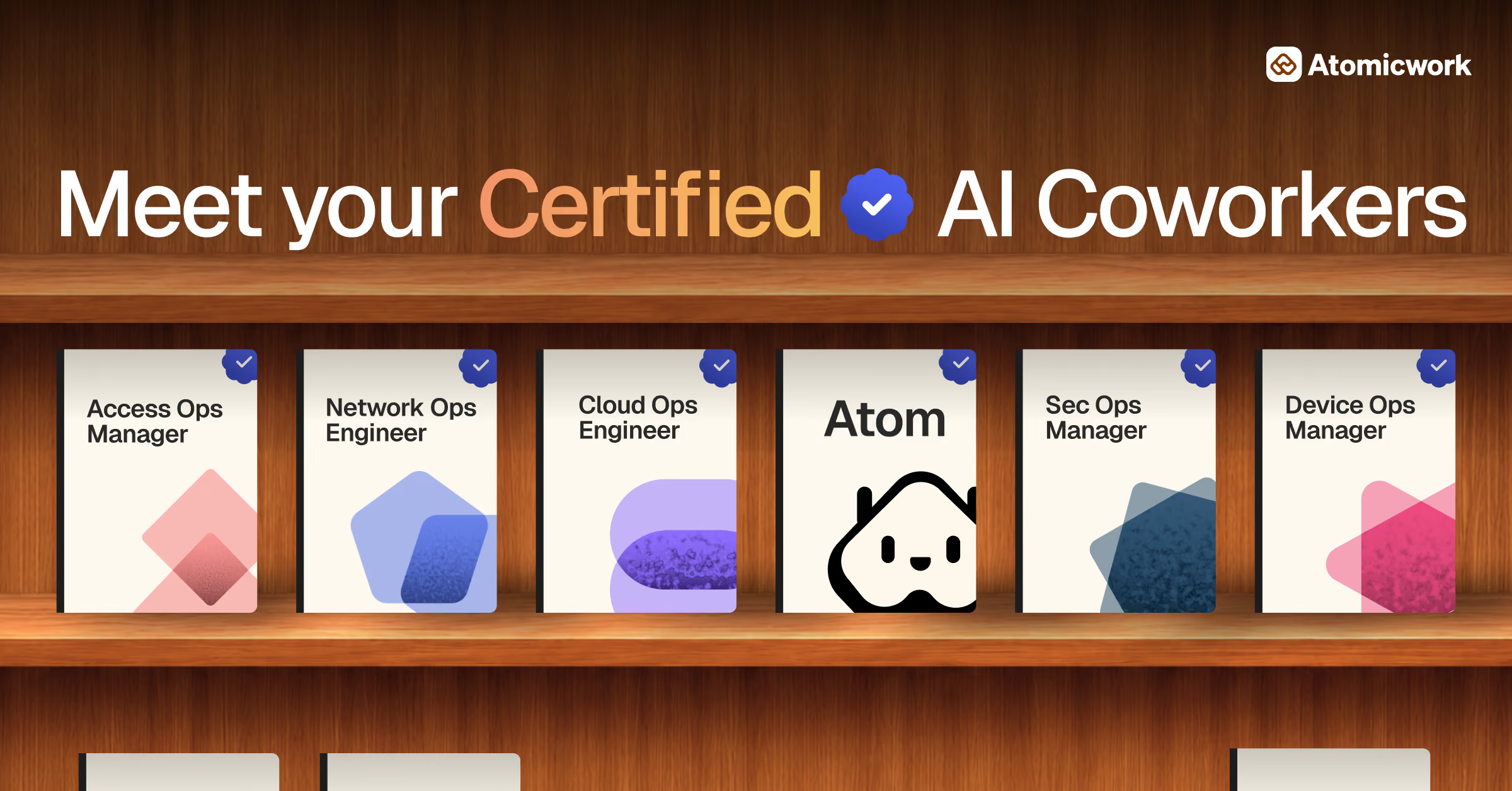
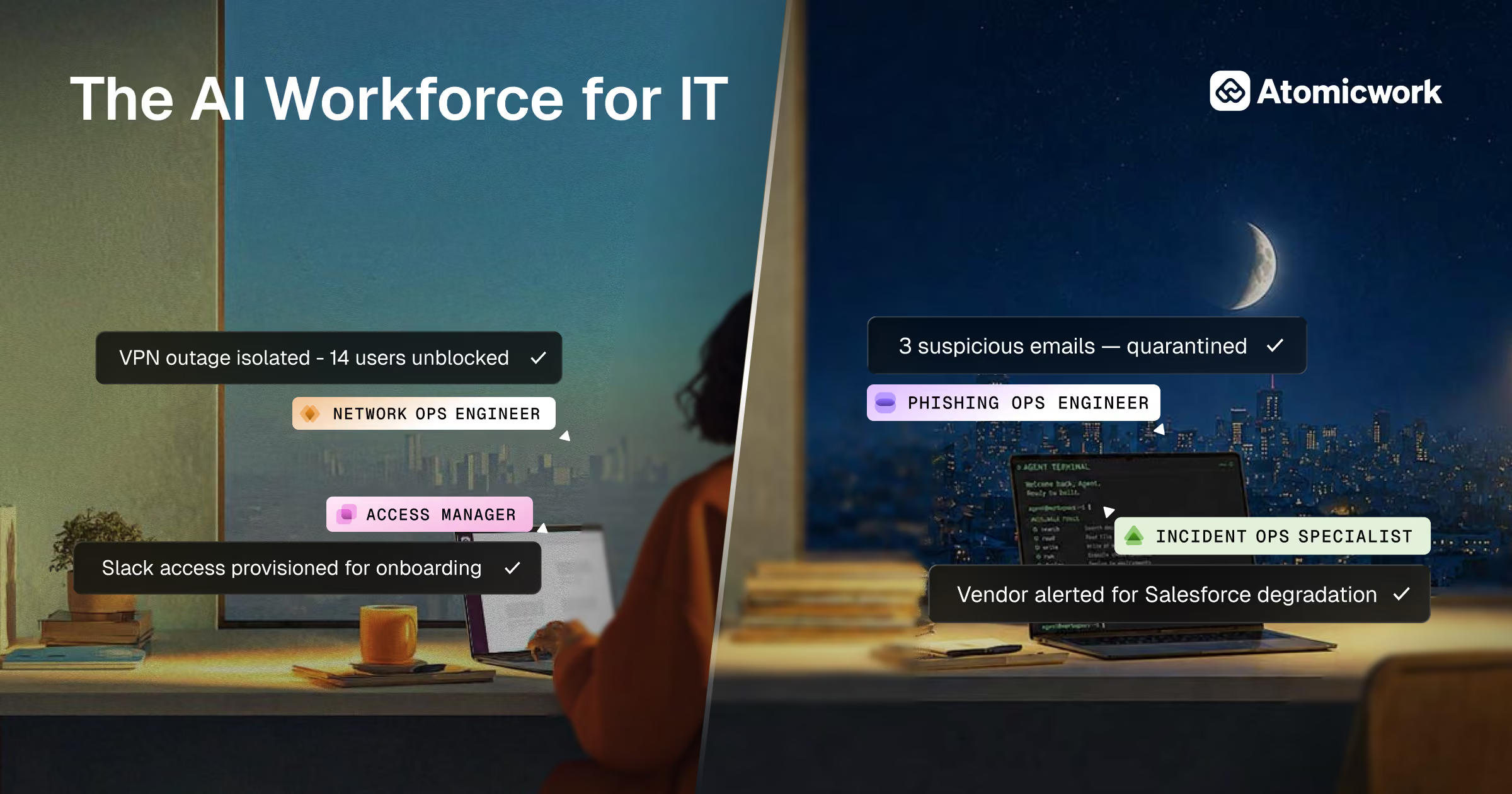
Atomicwork is an enterprise ITSM & ESM platform with the AI workforce to run it. Its AI Coworkers have a role, tools, a budget and a manager, and work on your requests, incidents, changes, assets and configuration records so they can own functional ops roles, end-to-end. For example, the Universal AI Coworker, Atom, serves employees across Slack, Teams, email, the browser and the portal, so it can help employees wherever they are; certified, pre-built AI Coworkers, each tested against a role-specific benchmark, automate key service operations like device ops troubleshooting and cloud ops investigation across the organization.
Teams that already run ServiceNow or Atlassian Jira Service Management can also run Atomicwork's AI Coworkers on top of that instance and move to the full platform later.
What is Serval?
Serval is an AI-native IT platform built to resolve requests, not just manage them. Its Catalyst agent turns a plain-language description into a TypeScript workflow. An admin reviews the generated code and publishes it, and at runtime a help desk agent matches each request to a published workflow.
Atomicwork vs. Serval: A Quick Summary
| Atomicwork | Serval | |
|---|---|---|
| Core approach | AI Coworkers, each with a role, tools and a budget, that runs the IT end-to-end | AI generates workflows as code that an admin reviews, and the approved code runs |
| What AI does | AI Coworkers work requests end to end, including ones with no prebuilt workflow, and hand them off to a person with a summary when needed. AI Assist manages the platform for you. | AI runs workflows that were built and published in advance. Requests outside them go to a person. Catalyst, the builder agent, creates the workflows. |
| Building workflows | AI workflow builder converts plain-language descriptions into visual workflows or code, plus teams can design and deploy AI Coworkers for ambiguous, multi-step cases that require judgement and reasoning. | Plain-language description turned into reviewed TypeScript deterministic workflows |
| AI governance | Atomicwork’s runtime architecture is built for AI safety. AI Coworkers are sandboxed with a network proxy and token-based credential isolation with granular per-tool Allow, Ask or Deny controls before any access. Guardrail code checks each call. Atomicwork’s guardrails also include financial spend limits including budget limits and audit trail. | Admin-reviewed code before anything runs, approval steps before actions, audit logs and role-based access |
| Security and compliance | SOC 2 Type II; ISO 42001 certification for AI management; supports ISO 27001, HIPAA and GDPR; region-specific hosting | SOC 2 Type II; GDPR; HIPAA alignment; cloud, hybrid or self-hosted in your own AWS account |
| ITSM depth | ITIL-aligned request, incident, problem and change management, with core features like major incident detection, CAB approvals and a change calendar; service catalog; smart CMDB with dependency mapping; asset management with built-in device discovery | Request, incident, problem and change management, with CAB approvals; CMDB with dependency mapping; assets synced from your existing tools |
| Chat and channels | Slack, Teams, email, browser and portal; plus, Claude, Cursor and ChatGPT; voice assist and screen share | Slack, Teams, email and web portal |
| Best for | Enterprise IT and business teams that want end-to-end ITSM and ESM in one platform | Engineering-led teams that want just code-reviewed automation |
Head-to-head comparison: Atomicwork vs. Serval features
Here is how each platform handles the work an AI-native service desk is bought for. For each area we cover Atomicwork, then Serval, then a verdict.
How each uses AI to automate employee support
Atomicwork: Atom is Atomicwork’s AI Coworker, purpose-built for employee support. Atom provides instant resolution in the flow of work, wherever employees already are: Slack, Teams, email, the browser or the portal. It answers from your trusted knowledge sources and can do the task itself, if allowed. Employees can also talk to Atom or share their screen, and it walks them through a fix step by step, like a colleague sitting next to them. Atom works alongside other AI Coworkers, to orchestrate tasks like access requests, new-hire onboarding, device issues, and HR questions. The recently launched certified AI Coworkers, like the Cloud Ops Engineer and Device Ops Engineer, have each been tested against role-specific scenarios and can be trained on your own policies and tools to handle the requests end-to-end.
Serval: A help desk agent answers questions and runs published workflows, and the Catalyst agent builds those workflows from plain-language descriptions. Serval also describes proactive background agents that look for problems and propose fixes. Requests that no published workflow covers route to a person.
Verdict: Atomicwork fits teams that want AI to also work through ambiguous, multi-step cases under a budget and a human manager besides the predictable workflows set up by the team. Serval fits teams that want predictable results: when it automates workflows, it runs reviewed code, so the same request gets the same outcome every time.
Workflow building
Atomicwork: Atomicwork lets your team describe a workflow in plain language and create it as code. AI Coworkers work on top of them: a Coworker reads the request, decides what needs to happen, runs the right workflow, and asks for approval before it changes anything.
Serval: Serval’s AI agent writes each workflow as code. Your team can read the code, check it and approve it before it goes live. It then runs the same way every time. Engineers can also keep workflows in Git and track every change.
Verdict: Serval is stronger if your engineers want to review and control the code. Atomicwork is easier to build and run, even for non-technical teams to start with.
Ticketing and request management
Atomicwork: Employees just say what they need. The AI Coworkers pick the right service, fill in the form and submit the request. Each workspace has its own service catalog, with categories, service-specific fields and visibility by group. Smart Routing assigns requests intelligently to the right workspace and group. Assignment skips agents who are away.
Serval: Employees ask in Slack, Teams, email or on the web, and AI fills in each ticket’s category and details. You can set routing rules, response-time goals (SLAs), and your own ticket types and forms. Its help desk agent can answer questions, but it can only act through workflows someone has already built and published. The rest goes to a person.
Verdict: Both cover routing, SLAs and custom ticket types. Atomicwork’s AI also picks the service and submits the request, while Serval’s agent needs a published workflow to act.
Incident management
Atomicwork: Atomicwork watches ticket volume and flags a possible major incident when it passes thresholds you set. After an admin acknowledges it, related tickets are intelligently clustered along with the affected assets, and a broadcast message updates everyone affected. AI Coworkers can summarize the incident and suggest likely causes and next steps as well as take actions as per the incident playbook to mitigate the incident.
Serval: Serval’s AI gathers duplicate reports under the first one and judges whether an outage is major by checking which services it hits and how important they are. A person approves the promotion. New related tickets link automatically, and broadcast reaches every requester.
Verdict: Both flag major incidents and need a person to approve. Atomicwork goes further by starting the research and drafting the RCA.
Change management
Atomicwork: Change management includes three change types with customizable templates, CAB and ECAB approvals and a change calendar. The AI Coworkers can’t make any change without approval.
Serval: Three ITIL change models (Normal, Standard, Emergency) with CAB and ECAB approval, locked statuses and impact tracking against affected assets.
Verdict: Both offer ITIL change models with CAB approval. Atomicwork adds a change calendar with conflict detection that shows planned changes and flags overlaps.
Problem management
Atomicwork: Atomicwork drafts a problem from an incident, then generates a task list from the linked incidents to guide root-cause analysis. Your team records the root cause and the fix, and every linked incident gets the update at once.
Serval: AI turns a ticket into a problem record and suggests fixes, such as a knowledge article or a new workflow.
Verdict: Both use AI to draft problems. Atomicwork also drafts the investigation tasks and updates linked incidents at once.
CMDB and asset management
Atomicwork: Built-in discovery feeds the CMDB and asset management. Discovery can be agentless or agent-driven with agents on every device that report in; scanners find unmanaged devices such as printers and switches. It also syncs with MDM tools like Kandji, Intune and Jamf, and Azure for a complete picture of the enterprise IT estate that maps how devices, people and services connect, so AI Coworkers can resolve issues with the context of who is asking and what they use as well as their support history. Atomicwork also supports intelligent deduplication and reconciliation. The same device arriving from MDM, discovery and procurement is reconciled across several attributes, so you don’t end up with duplicate or orphaned records.
Serval: A built-in CMDB shows what each service depends on, alongside hardware and software asset records. Data comes from tools you already run, such as Jamf, Intune, Meraki and Cisco Catalyst Center, or from manual entry and CSV. Audits check records against physical scans.
Verdict: Serval fits teams that already know what they own. Atomicwork adds built-in discovery for devices you may not know about.
Channels and employee experience
Atomicwork: The Universal AI Coworker, Atom, works in Slack, Teams, email, the browser, and the portal. Employees can also reach it from AI clients they already use, such as Claude, Cursor and ChatGPT. They can chat, talk by voice or share their screen, and Atom guides them through the fix.
Serval: Employees ask in Slack, Teams, email or on a web portal.
Verdict: Serval covers only chat. Atomicwork is multimodal: employees can talk, share their screen or send a screenshot, so they can show a problem instead of describing it.
HR, Finance and Facilities service delivery
Atomicwork: Each team gets its own workspace with separate privacy and admin controls, so HR can build its own forms, workflows, and SLAs. An HR Ops Specialist AI Coworker answers questions on onboarding, policies, benefits and time off, and an Onboarding Manager coordinates new-hire setup. It integrates with HR systems such as Workday, ADP, BambooHR and Rippling to sync employee data and process leave requests.
Serval: Serval started in IT and now serves People teams too. It connects to HR systems like Workday, Rippling and BambooHR to automate onboarding and offboarding, look up PTO balances and handle sensitive requests.
Verdict: Both connect to your HR system and automate onboarding and offboarding. Atomicwork goes further for HR: its own workspace with separate privacy controls, plus AI Coworkers that resolve cases like new-hire setup and employment letter generation can offload routine tasks from HR teams.
Governance and AI control
Atomicwork: Every AI Coworker runs in an isolated sandbox with network access limited to the destinations you allow, and it never sees your credentials. You set each tool to Allow, Ask or Deny, so safe work runs instantly and anything more waits for a person. Guardrail code checks each call before action. Each Coworker has a budget that pauses it for review at the limit, and every action is logged in a full audit trail.
Serval: Governance comes from reviewed code that runs the same way every time. Workflows can pause for approval, actions are logged, and access is role-based.
Verdict: Both give you workflows that behave the same way every time, with approvals and logs. Atomicwork also governs the AI Coworkers themselves: what they can reach, which tools they can use, what data they see and what they can spend.
Security and compliance
Atomicwork: Atomicwork holds 10+ certifications and attestations, including SOC 2 Type II and ISO 27001, plus ISO 42001 for AI management. It also complies with GDPR and HIPAA, and offers region-specific hosting in EU or the US.
Serval: Serval documents SOC 2 Type II, GDPR compliance and HIPAA alignment. It can run in the cloud, as a hybrid, or self-hosted in your own AWS account.
Verdict: Atomicwork adds ISO 42001, an AI management standard which Serval does not offer. Serval offers self-hosted deployment.
Pricing and cost
Atomicwork: Atomicwork publishes its pricing, so you can budget before a sales call. You can pay by usage, with credits drawn down as AI Coworkers work, or by outcome, with a fee per result such as a resolved knowledge query or a handled access request. Each AI Coworker has a budget that pauses it for review at the limit. Teams on ServiceNow or Jira Service Management can add AI Coworkers on top with no additional platform fee.
Serval: Serval does not list prices. Its pricing page offers two ways to work, as the full system of record or as a layer on top of your current platform, and every engagement starts with a pilot and a proposal.
Verdict: Atomicwork has very transparent pricing, and you can customize it to your needs. Serval starts with a pilot and a proposal.
How to evaluate between Atomicwork vs. Serval
Use these questions to decide, and put the same ones to both vendors.
- What happens to a request no workflow covers? Does the AI work through it, or does it go to a person? Test with ten real requests you haven’t built anything for.
- Who will run it? Any service team, not just engineers: IT, HR, finance and facilities. Check that each team can build its own forms, workflows and SLAs, in plain language, and keep its own privacy controls.
- How many ITSM practices does it support? If you want incidents, problems, changes, assets and a CMDB in one place, check each practice. Look for a change calendar, a service catalog with categories and fields per service, and discovery that finds devices you don’t know about.
- How is the AI controlled? Look for tool-specific access: you decide, tool by tool, what runs on its own, what waits for a person and what is blocked. Check that it applies whether the AI reasons through a case or runs a fixed workflow, with network limits, code checks on each call, budgets and an audit trail.
- What will security and finance need? Ask for certifications, data residency, pricing, limits and pilot terms in writing.
- Does it work with your stack? Test your identity, HR and device tools, plus any custom integrations, in the pilot, not on a slide.
Why choose Atomicwork over other AI ITSM tools?
AI works best on good data and inside clear limits. Atomicwork is built for that.
- AI you can train: Your team can design and deploy its own AI Coworkers and set them up for any repetitive use case. Tool-specific access lets you set each tool to Allow, Ask or Deny, and guardrail code checks every call.
- One platform, one set of records: Requests, incidents, changes, assets and configuration live together, and Universal Context adds the history of your users, assets and helpdesk history. AI Coworkers work from the same information your team does.
- Built for more than engineers: Teams build workflows by dragging blocks or describing them to an AI builder, and HR, finance and facilities get their own workspaces.
- Start without replacing anything: AI Coworkers can run on top of ServiceNow or Jira Service Management, and you can move to the full platform later.
- Pricing you can see: Pay by usage or by outcome, and budget before a sales call.
The fairest comparison is a pilot of each against the same real requests. See how Atomicwork's AI Coworkers handle real service desk work.


Frequently asked questions