
How IT will run the AI workforce: From AI agents to AI coworkers

AI agents are already showing up across enterprise IT. But as they move from answering questions and executing individual tasks to taking on complete job roles, IT teams have a new question to answer: how do you actually manage an AI workforce?
In our recent webinar, I was joined by Aparna, our Head of Product, to unpack how AI coworkers are different from AI agents, what it takes to manage them alongside human employees, and how IT teams can start bringing them safely into their operating model.
Here are my key highlights from the conversation.
How we got from AI assistants to AI coworkers
Aparna started by walking through how quickly AI in IT has evolved.
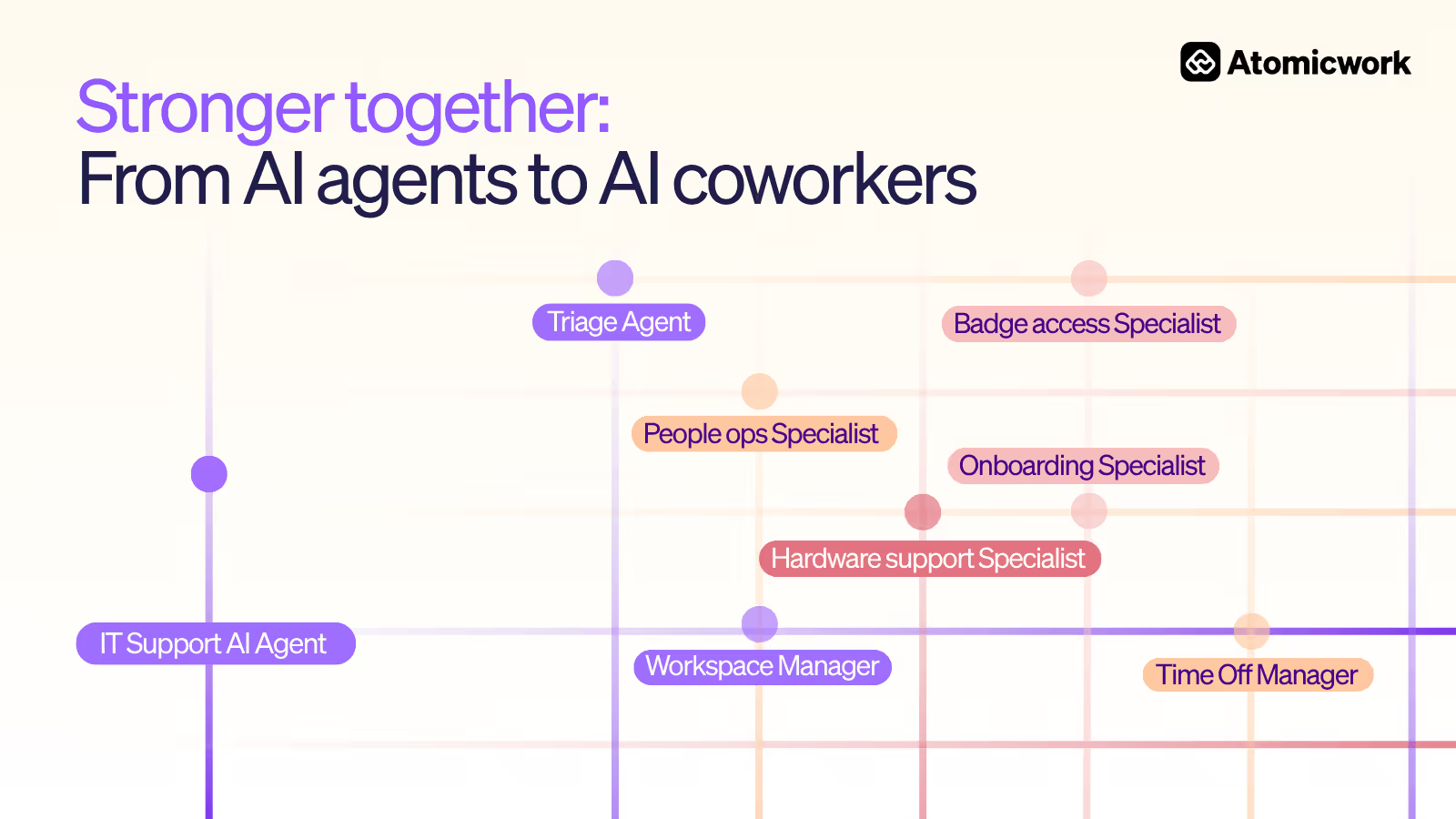
RAG-based assistants gave IT teams a way to answer employee questions and surface knowledge. Reasoning models took that further by helping troubleshoot problems, understand employee intent, and make more complex decisions. Then came AI agents, which moved AI from answering to acting: calling tools, updating systems, creating tickets, triggering workflows, and provisioning applications.
The next evolution is AI coworkers that can take on complete job roles.
An AI coworker isn't simply an assistant answering questions or an agent executing an action. It has an identity, a defined role, access to tools, goals, budgets, and performance expectations. It can own responsibility for a body of work and be measured and improved over time.
Think of an Access Manager that owns provisioning and deprovisioning or a Device Ops Manager responsible for diagnosing and patching endpoint issues.
As AI begins taking on roles rather than individual tasks, it stops being purely an automation conversation. It becomes an operating model conversation.
What changes when AI becomes part of the workforce
One of the most useful parallels from the session was that many of the constructs we already use to manage human employees also apply to AI coworkers.
Identity: AI coworkers shouldn't be anonymous bots operating in the background. They need their own identity, agent ID, and service account so organizations know which coworker performed an action, under which permissions, and in which system.
Job role: Every coworker needs a clearly defined job. What work does it own? What goals is it responsible for? Which team does it belong to? And who manages it?
Lifecycle: AI coworkers need to be onboarded, configured, monitored, improved, and eventually deprovisioned. Their instructions, tools, permissions, and responsibilities may all change over time.
Skills: For an AI coworker, skills come from the knowledge it can access, tools it can use, workflows it understands, and instructions it's given. Those skills should improve as it handles more work and learns from outcomes.
Access: Permissions should be tied to the coworker's job and limited by policy. AI coworkers can operate at a scale humans can't, making clearly defined access boundaries even more important.
Performance: Completing a task isn't enough. IT needs to know whether the work was accurate, complete, safe, and compliant with policy.
Budget: AI coworkers consume resources through model calls, tokens, APIs, tools, and workflows. IT needs visibility not only into what they're doing, but what it costs them to do it.
Together, these become the foundation for managing AI as part of the workforce rather than another collection of disconnected bots.
Don't automate tasks. Start by staffing a role.
When IT teams think about AI, the natural starting point is often: what tasks can we automate?
Password resets. Ticket categorization. Notifications. Individual workflow steps.
Aparna suggested flipping that question.
Inventory the jobs, not the tasks.
Look at the roles that repeatedly show up across the service desk: Access Manager, Onboarding Manager, Device Ops Manager, Incident Ops Lead, and others.
Then choose one role where the volume is high but the risk is relatively low. Avoid starting with something like major incident management, where decisions need to happen quickly, the consequences of an error are significant, and human judgment is critical.
Access management can be a strong starting point because it's high-volume, measurable, and can be scoped down before expanding.
From there, define what good looks like before deploying the coworker. Set the KPIs. Measure how much work it resolves without escalation. Evaluate its accuracy and policy adherence. Improve its skills and expand its responsibilities as it earns trust.
And most importantly: give it a human manager.
Every AI coworker needs someone accountable for its scope, permissions, performance, and escalation paths. Without clear ownership, it's easy for an AI pilot to become something that's deployed broadly but actively managed by no one.
The AI workforce needs a performance loop
The session also raised an interesting question: if AI coworkers are treated like team members, can they actually get better at their jobs?
Aparna broke AI coworker performance into three categories:
- Outcome metrics: Did it resolve the request? What was the impact on SLA or CSAT?
- Quality metrics: Was the work accurate, complete, policy-compliant, and free from hallucinations?
- Operational metrics: How much latency, token usage, tool usage, and cost did the work require?
The interesting part is that AI itself can become part of this evaluation process.
Rather than manually sampling a small percentage of work, AI can continuously evaluate a coworker's output against these rubrics and identify where it could improve: better instructions, additional skills, new tools, or different access.
Eventually, that creates a feedback loop where AI coworkers don't simply execute the same instructions repeatedly. They learn from their work and improve how they perform the role.
IT will become the operating layer for the AI workforce
During the session, we referenced Jensen Huang's prediction that IT will become the HR department for the digital workforce.
That future is starting to look much less theoretical.
As AI coworkers become part of enterprise teams, someone needs to give them identities, onboard them, define their jobs, control their access, manage their skills, measure their performance, set their budgets, and eventually offboard them.
Much of that responsibility will sit with IT.
The shift ahead isn't simply from manual work to more automation. It's from managing software and workflows to managing a workforce made up of both humans and AI.
And the IT teams that start building the operating model for that workforce now will be much better prepared for what comes next.
Access the full session recording here.



.avif)
