The automation ceiling was never about software: Introducing AI Workflow Builder

There is a problem in enterprise software that doesn't get talked about enough: the gap between knowing what you want to automate and being able to actually automate it.
Most teams understand their processes intuitively.
An IT admin knows that when a laptop replacement request comes in, it should check the asset inventory for available models, factor in the employee's role and location to determine the right spec, route the approval based on cost band, and trigger procurement only after everything lines up.
An HR coordinator knows that when an employee transfers between departments, it's not just an org chart update but a sequence of access revocations, new provisioning, manager notifications, and compliance documentation that has to happen in the right order.
The knowledge is there and the logic is clear but translating it into an automated workflow has always been harder than it should be, and for the following reasons that compound on each other -
Platform fluency: Every workflow engine has its own mental model - its own trigger types, field references, conditional syntax. Learning to think in those constructs takes time. Most IT admins aren't starting from zero. They've built workflows in Zapier, or PowerAutomate. That prior fluency gets in the way. You carry assumptions about how things should chain, how conditions should nest, and the new platform breaks them in quiet ways. It's not a learning curve, it's an unlearning curve too.
Capability ceiling: Most platforms only offer pre-built primitives. If you need to loop through a list of related tickets, compute a dynamic threshold, or parse a field with custom logic, you hit a wall. Your process is more sophisticated than what the builder can express. At that point you have two bad options: simplify the process to fit the tool or file a feature request and wait. There are workflows that could exist but get quietly simplified or abandoned because the tool can't keep up with the complexity or the logic.
Organizational bottlenecks: The person who understands the process isn't the person who can build the workflow. HR knows their onboarding flow cold, but the build is often done by IT. IT has a queue. The workflow either gets deprioritized, built months later by someone who doesn't fully understand the context, or just never happens. This is a structural problem - you've created a permanent dependency between the people with domain knowledge and the people with platform access.
Maintenance drag: Workflows evolve. A threshold changes, a new approval step gets added, a team restructures. Every change goes back through the same bottleneck: either the person who built it remembers how it works, or someone reverse-engineers the logic from the visual builder. Workflows become fragile because nobody wants to touch them.
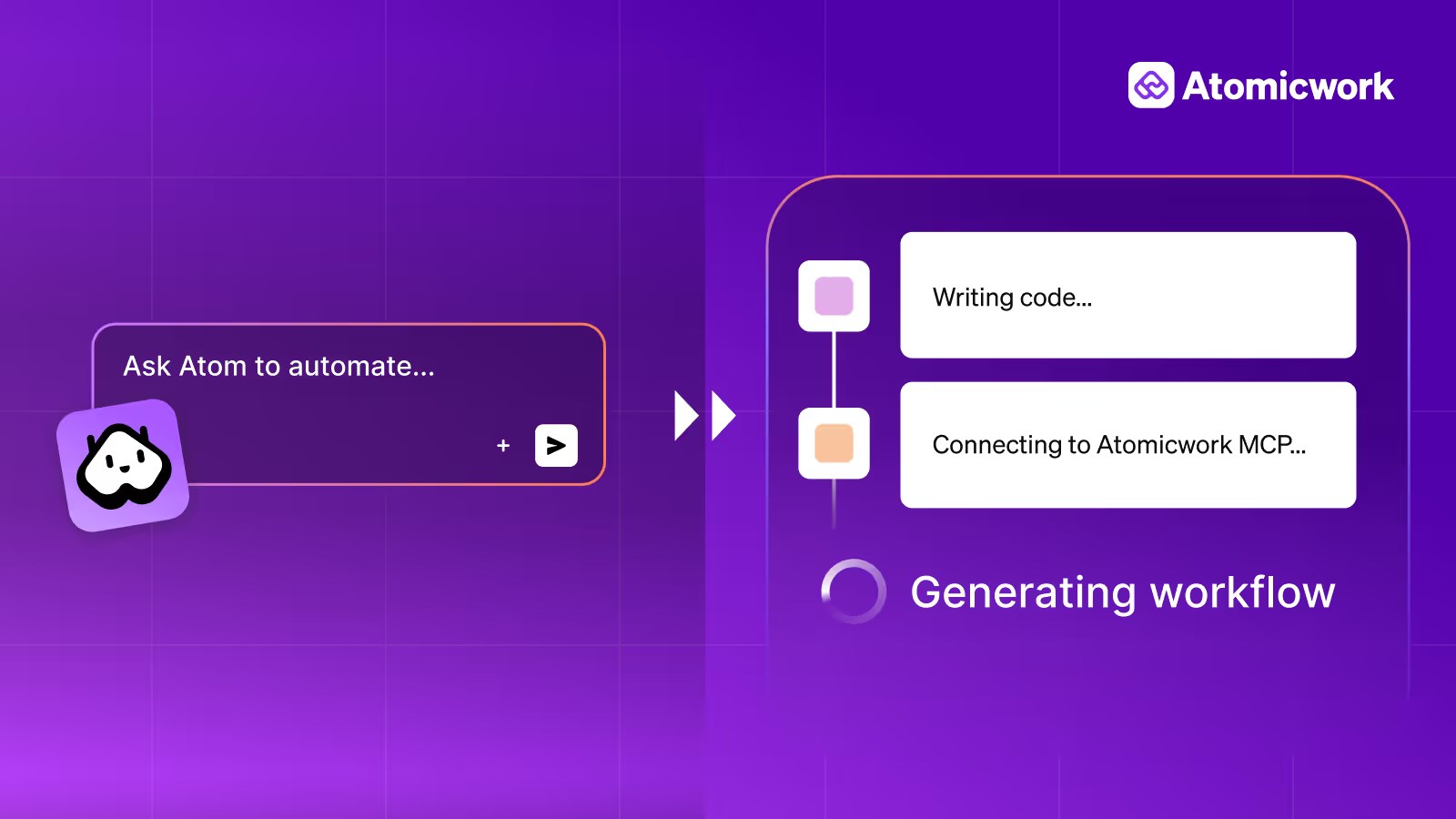
Atomicwork’s AI Workflow Builder removes that ceiling, not by giving you a simpler way to assemble the same building blocks, but by letting AI build new ones for you. Describe what you need in plain language, and Atom, our universal AI agent, constructs the workflow - writing custom code where the platform's native actions fall short. You're no longer constrained by what the builder offers. You're constrained by what you can describe and what tools you’ve given it access to.
Getting here meant making a few deliberate design choices that separate this from the "describe a workflow in natural language" demos that float around.
Extend the platform, don't just translate it
If you use natural language to describe a workflow and the AI maps it faithfully to your platform's native actions, you're still limited by what those actions can express. You can do what the platform could do before; you just get there with less effort. That has value, but it's not the value unlock.
The real shift is the Execute Code action. When Atom encounters a requirement that can't be satisfied with native actions it writes the code itself. You describe what the workflow should do, and Atom figures out how to build the parts the platform doesn't have pre-built primitives for.
We didn't want this to be a simplified mode or a "lite" builder that works for basic automations but falls over the moment you need a webhook, a third-party action, or a complex branching condition. AI Workflow Builder has access to every Atomicwork workflow construct and every connected integration, whether it's a native action or an external system reached through a webhook.
Built for the team that owns the process
A natural language workflow builder that only IT can use is a faster version of the same bottleneck. We didn't want that. We wanted the person who understands the process to be the person who builds the workflow. We wanted to remove technical expertise that came with building workflows. When the cost of building drops, the number of people who can build goes up.
This mirrors a pattern we're seeing with AI adoption more broadly. When the complexity of a task gets abstracted into natural language, the pool of people who can do it expands dramatically. Marketers are writing SQL. Product managers are building prototypes. People are venturing into territories that used to require specialized skills. The same principle applies here - HR coordinators, finance teams, and facilities managers can now build and own workflows that used to require IT to deliver. When the person who understands the process is the person building the workflow, the result actually matches the intent.
Built to evolve, not just to launch
Building a workflow is a one-time cost. Maintaining it is an ongoing one.
With the AI Workflow Builder, you can come back to a workflow weeks or months later, describe the change you need in plain language, and Atom modifies it - understanding the existing structure and adjusting it rather than rebuilding from scratch. The same applies to troubleshooting: instead of tracing through nodes to find where something went wrong, you can describe the issue and have Atom identify and fix it.
This is the part that closes the loop. If your AI builder only helps with the creation, the bottleneck just gets moved downstream.
Transparent and always auditable
AI-generated workflows that you can't inspect, version, or debug aren't going to make it past an IT review, and they shouldn't. We didn't want the AI Workflow Builder to be something teams try in a sandbox and never move to production.
Every workflow Atom builds lands on the same visual canvas as a manually built one. You can open it, inspect every node, every condition, every code block. You can hand it off to someone who wasn't involved in the original build and they can read it, modify it, extend it. There's no opaque AI layer sitting outside your existing workflow environment.
Version history tracks every change - who modified the workflow, what changed, and when. Error logs surface what went wrong and where. These features are the reason an IT lead can look at an AI-built workflow from a finance team member and say "yes, this can go live."
The ceiling was never about what the software could do. It was about who could use it.
We thought that was worth removing.