Still Human: Mental Health in the Age of the AI Workforce

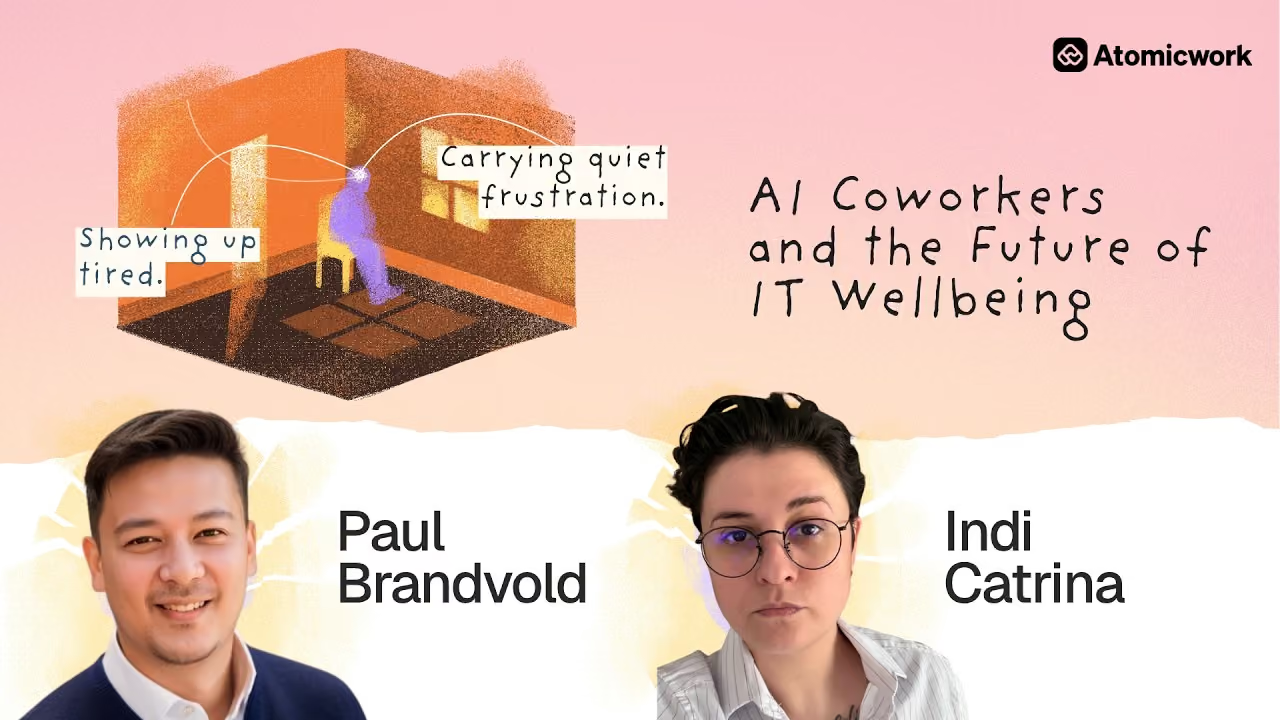
Near the end of our conversation, Indi Catrina referenced James Joyce. She was talking about the closing of "The Dead" — a character standing at a window, watching snow fall on everything equally, on what is living and what is already past. It is not a sad ending, she said, though you might mistake it for one. It is an honest one. A recognition that we are all inside something larger than the particular difficulty of this moment!
That analogy is exactly what this conversation was about.
The AI transformation is falling on the junior engineer just entering the market, the senior who spent 15 years building expertise, the manager trying to hold their team together, and the CIO trying to set direction. Nobody is exempt or watching from a safe distance. The snow falls on all of us equally!
Last year, we sat down with Paul Brandvold and Indi and talked about the quiet toll of working in IT — the burnout nobody notices, the work that goes unseen, the people holding everything together while nobody holds them. It resonated more than we expected. So we came back with a year's worth of industry change sitting between us!
In the last twelve months, the world that IT professionals live in has shifted in ways that are hard to articulate and even harder to process. AI coworkers are owning job functions. Layoffs have hit companies that were supposed to be thriving. Teams are being asked to do more with less, adapt faster, and stay okay while doing it. The mental health conversation in IT has never been more urgent — or more complicated.
What followed was one of the most honest conversations we've had. Here's what we took from it.
The hidden cost of working in IT
IT success is, by design, invisible. When the infrastructure holds, when the patch gets applied before anyone notices the vulnerability, when the incident doesn't happen — nobody writes a case study about the crisis that was quietly prevented at 3am on a Tuesday. There are no awards for disaster that didn't occur.
Indi named this with precision: "You get blame when things fail and you're invisible when they succeed." And with the rise of AI coworkers taking over work that was once done manually by real engineers working around the clock, the light on those individuals has dimmed further.
But it's the nature of burnout in IT that makes this particularly hard to address. Paul was clear about what it actually looks like: it doesn't look like a breakdown. It looks like silence. It looks like the person who used to challenge decisions in meetings going quiet. It looks like cynicism that gets mistaken for pragmatism. It looks like people who used to care deeply, performing competence without bringing themselves to the work anymore.
Paul also flagged something leaders often miss: the "yes people." The ones who say yes to everything — not just the workload their manager assigns, but whatever anyone else in the organization asks of them, because they've become the unofficial go-to person. As much as we love those people, Paul said, we have to protect them against themselves sometimes.
The always-on culture makes all of this worse. The expectation of availability — the 11pm message, the Sunday escalation, the implicit understanding that emergencies don't respect boundaries — accumulates not as individual incidents, but as a permanent, low-level cost that the person is paying too often to name out loud.
Leadership and psychological safety
"Psychological safety" has become one of the most used, abused, and misunderstood phrases in leadership. Indi wanted to be precise about what it actually means — because the gap between what it claims to be and what it is in most organizations is where the real damage happens.
Psychological safety is not created by saying "it is safe to speak up." It is created by what happens after someone does. She's watched well-intentioned leaders tell their teams that the door is open, that honesty is valued — and then when someone brings them the real thing, their body language shifts, the message gets managed, and the person who raised the concern finds themselves quietly outside the circle in ways nobody names but everyone feels.
When you're in a meeting and nobody pushes back, ask yourself honestly — is this alignment, or is this what alignment looks like when people have stopped believing it's safe to disagree?
Paul echoed this and added a practical anchor: give feedback on the input you receive. Acknowledge it. If you're going to get back to someone, actually get back to them. Small, consistent follow-through is what builds trust — not policies, not values statements.
And then there's corporate language. Indi drew on Orwell — who was writing about politics, but whose insight applies exactly to how organisations communicate during difficulty. Vague, abstract language is almost never accidental. When you say "talent evolution" instead of "your role will change beyond recognition," the language is working to create distance between the word and the thing. People feel that distance. Once they start feeling it, it's very expensive to undo.
What she's seen actually work is harder than it sounds: leaders who are willing to say the actual thing. Who can sit with discomfort without performing confidence they don't have. Who can say "I don't have all the answers — here is what I know, here is what I don't, and here is how we're thinking about it together." That, she said, is not weakness. It's the only thing she's ever seen actually build trust when the ground is shifting.
The AI anxiety nobody is naming honestly
There are two conversations happening about AI right now, and they are being dangerously conflated. Indi was clear about this, because the conflation is making the anxiety worse and stopping organisations from focusing on what actually matters.
The first conversation is about AI as a tool — ChatGPT in your workflow, automation of repetitive tasks, doing what you already do faster. The second is about AI as a workforce strategy — agentic AI that owns whole job functions, structural changes to headcount, roles that no longer exist in the same form they did three years ago. Most people sitting in organisations right now cannot tell which conversation they're actually in, because nobody is telling them clearly. And that ambiguity is where the real anxiety lives.
Paul reinforced this: the distinction matters, and leaders owe their teams honesty about which one is happening. Transparency beats vague reassurance, every time.
But Indi took it somewhere deeper. A few months ago, a senior colleague — someone who had spent years building genuine expertise, real judgment, the kind of knowledge that takes time to grow — said to her: "I don't know what I'm worth anymore." Not I'm worried about my job. Not what does this mean for my role. Something deeper and more honest than that. A question about value. About identity. About whether the thing she had built still meant what she thought it meant.
That's the conversation most of us are actually having underneath all the transformation frameworks and the productivity decks and the change management playbooks.
Naming what's real: grief, identity, and what we're not saying
Underneath all the noise about AI transformation, Indi said, people are grieving. And nobody is giving them permission to.
Not dramatic loss. Not catastrophe. But the specific psychological experience of something mattering to you — your competence, your identity, your sense of what you bring — and watching the ground shift under it. People who spent a decade building genuine expertise, watching that knowledge compress. Watching something that took years of development happen in seconds. There is no clean emotion for that. It's not exactly fear. It's not anger. It's something closer to disorientation.
The version of work that existed before, it mattered, it's changing, and it's a real thing that deserves to be said out loud.
When organisations skip straight to adaptation, they get compliance without genuine engagement. People learn the new language, use the new tools, and underneath it all, they're carrying unprocessed loss that shows up as disengagement, cynicism, and burnout.
Paul connected this to something personal — a sports injury when he was younger that took away the identity he had built around the game. Who am I now? That question, he said, is exactly what a lot of IT professionals are sitting with right now. And leaders need to make space for it, not manage it away.
Indi added one more distinction that matters: the difference between resilience and agency. Resilience is about absorption — how much you can take, how quickly you bounce back. There is a version of resilience culture that treats people as shock absorbers for organisational change and calls it a compliment. Agency is different. People can endure extraordinary amounts of uncertainty when they have genuine agency. What erodes mental health is not difficulty. It is helplessness.
And she ended this thread simply: "Be a human being at work. Ask people how they are and wait for their actual answer. Notice when someone goes quiet. Those are not HR competencies. They're human skills, and we already have them."
Reclaiming time and what becomes possible
The question we ended on was this: when AI coworkers take the load, what does that actually free up? Not in terms of productivity metrics, but in terms of what becomes possible for the humans still in the room.
Paul was honest that most organisations are still in the early stages of AI maturity — the technology is here, but most companies haven't caught up to it. The first year has been harder than expected because expectations were set from the top down without a clear understanding of integration. But he's optimistic. Within the next year or two, he thinks we'll be much better at leveraging what AI can actually do. Things need to get worse before they get better. And they will get better.
Indi went somewhere more philosophical. What AI is giving back, she said, is not spare time. Spare time is a concept. What it's giving back is something closer to our own nature — the chance to get bored again. To reflect. To develop empathy. To think about the people you've worked with, the conversations that mattered. We lost that about twenty years ago when the internet made being unreachable feel like failure. AI, used well, might be the thing that gives it back.
It is not the AI that is scary. It's what we do with it. And what it can give us back is not spare time — it's the chance to recompose ourselves against our own nature.
What we're taking away
Paul closed with something that applies at every level: people can handle uncertainty much better than silence. They don't expect their leaders to have all the answers. They do expect honesty. And they are more resilient than we give them credit for — as long as we give them something real to hold onto.
Indi closed with the thing she had been sitting with since they started preparing for the session. Everything they had talked about — the grief, the identity, the exhaustion, the silence, the resilience, the agency — was, underneath it all, one single thing. A love letter to the human race. Not a sentimental one. A clear-eyed, honest, fully informed love letter, written by someone who works with AI every day, who knows what it can do, who is not afraid of it, and who chooses — with full knowledge — to believe that what remains human is not a remainder.
It is the point.
The snow is falling on all of us. On the living and the already past. On what we built and what we are still figuring out. None of it is happening to us uniquely or alone. And there is something in naming that together — not comfort exactly, but something close to it.
The technology will keep moving. The people are what you actually have. Check in on them — not as a process, not as a wellness initiative, but as one human being to another.