What Zuora and Lightmatter learned putting AI Coworkers to work


Plenty of IT teams have run a successful AI pilot. Far fewer have put AI Coworkers into production, where they act inside the enterprise: provisioning access, resolving tickets, and touching real systems and data.
At Oktane 2026, our Head of Product Aparna Chugh sat down with two IT leaders who have made that leap with Atomicwork's AI Coworkers: Mark Gill, Head of IT, Infrastructure and Security Operations at Zuora, and Aaron Katske, Head of IT, Security and Facilities at Lightmatter.
They made for an interesting combination because Zuora is a Slack-first SaaS company with ticket counts in the thousands and, as Mark put it, not enough people to deal with them, and Lightmatter, a photonic chips and interconnect manufacturer, has an IT team of 3 supporting a team of 300. Different estates, different starting problems, and four startlingly similar lessons.
Here's a summary of their experience as per the session, edited for the format:
1. Building it yourself teaches you what you actually need
Before Atomicwork, Zuora's first AI transformation move was to build its own service agent on Slack. A consulting firm helped the team put an LLM layer on top of Jira Service Management, their previous ITSM solution, so they could handle employee requests on Slack. However, this was not a successful initiative.
We knew we needed to change our thinking about data, context. If that's not organized and thought out ahead of time, you have no hope. You have no chance. Because everything the models do, they need to refer to that for the appropriate context. - Mark Gill, Zuora
Then came the rest of the iceberg: approval matrices, integrations, the knowledge layer — all of it to be built by hand, all of it to be maintained by hand. "It was gonna be a really long manual journey." That's what sent them looking, and what led them to Atomicwork.
The switchover is our favourite detail. Zuora renamed Atom — our employee-facing AI coworker — to Zoe, "Because everything at Zuora has to start with a Z, of course." Employees saw a new name. Everything underneath it had changed, and nobody outside IT knew.
Lightmatter arrived at the same place from the other direction. Aaron went looking in the ITSM landscape with one non-negotiable: a genuinely good Okta integration which they couldn't build themselves. Their Atom is called Prism, because everything at Lightmatter has to be about light.
2. Start where the volume is
Zuora mapped its top 50 use cases before Zoe went live, then worked down the list. Password resets, meeting room requests and eventually, the long tail. Today, Atom deflects 92% across the top 25 use cases and more than half of all incoming questions never become tickets at all.
The gains weren't only in complete deflection. Better tooling for human agents also dramatically shortened resolution times:
Agent experience tools like routing and auto-tagging, and some of the other things took our MTTR from 26 hours to five. — Mark Gill, Zuora
For Lightmatter, the obvious starting point for automation was access. Roughly 70% of its tickets were access requests, and IT often wasn't the one working the ticket end-to-end.
In a lot of cases, a manager is approving the cost, and the app owner is approving whether that's the right security profile. IT was really just a facilitator. — Aaron Katske, Lightmatter
So Lightmatter started their AI Coworker on its most ticket-heavy, most complex applications. "You want to put your best-performing tools on your worst-performing subjects," Aaron said. The results: 31 apps are now provisioned automatically with the fully automated workflows taking 19 seconds and the human-in-the-loop workflows going through in 24 hours on an average.
19 seconds is what people can reliably expect from an automated process. — Aaron Katske, Lightmatter
Automated fulfilment of access requests went from under 10% at the start to 84% today.
It's one of these things where the automations run and we don't even know. Then when we run the ticket report, you're like, hey, we have a lot of tickets... oh, it did most of them. — Aaron Katske, Lightmatter
3. Adoption is a change-management problem, not a technology problem
Both leaders said the tooling was the easy part. Mark's playbook was demo sessions, plus a few senior leaders talking about Zoe in every all-hands:
"Every time they're doing an all-hands meeting, they're talking about, hey, I just used Zoe to figure out what the Wi-Fi password is. Once that momentum builds, other departments come to you because they can use the same structure you've already built."
Which is how Zuora started with IT but also ended up launching HR, Workplace and Finance workspaces, routing requests to the right one without the employee having to know it exists.
Aaron took a slightly different approach. He brought business leaders into pre-sales — showed them the vision before there was a contract — and by launch day they weren't being rolled out to, they were invested. Lightmatter went live with HR, Facilities and Marketing alongside IT. The People team's actual pain turned out to be someone having to watch a Slack channel full of benefits questions all day, which Prism simply absorbed.
He knew it had landed when someone pinged him worried they'd filed a ticket wrong.
They thought they did something wrong because it wasn't instant. — Aaron Katske, Lightmatter
It's changed what Lightmatter buys. When they went for a new HRIS, the first question came from the people team, not IT: does it work with our AI coworkers? "They've become champions, and it's part of the business requirements now, which is great, because I don't have to be the bad guy."
There are a lot of really good opportunities for employees to champion your solution for you, if you give them the ability to self-serve. — Aaron Katske, Lightmatter
Lightmatter has a mandate to be more innovative with AI and a mandate to stay secure, so Aaron always tries to figure out how he can build a path rather than a wall: an employee near their usage limit asks Prism for more spend, the right approver signs off, and it provisions. Faster than hitting a wall in Cursor and filing a ticket about it — and more visible, which is the point.
4. Trust comes from visibility, and it has to be maintained
Letting an AI agent act inside your identity system takes confidence. For Lightmatter, that came from Atomicwork's tight Okta integration, with rules and policies enforced behind the scenes, and from being able to audit every action:
Whether it's an automation, the AI itself, or the AI calling a deterministic workflow, we can see it all. — Aaron Katske, Lightmatter
Aaron then turned the table on Aparna, the moderator, and asked the question every IT leader should ask their vendors: that's great on day one, but what about 12 months later when the audit logs can fill entire rooms? Aparna explained why AI is different from traditional software:
Agents drift over time. Maybe because the model changed, but also because the access you've given them is changing, and the knowledge the agent is consuming is changing. That's why Atomicwork built self-improving AI coworkers.
Teams define the behaviors that matter, whether intent, security or compliance. Atomicwork then evaluates production traces against those behaviors and flags what needs to change. Governance continues after go-live.
Ask Mark what keeps him up and the answer isn't Zoe. It's everything around Zoe. Zuora has rolled AI out to everyone. Everyone has their own tokens. And people have worked out they can use them.
Lots of people discover they can use their own token, and they go start manipulating data. So the data part worries me. — Mark Gill, Zuora
He wants an AI gateway, some kind of catalog layer, a control plane for the sprawl. "Neither of these things is completely solved for us and that's the next stage."
What's next: an agentic army
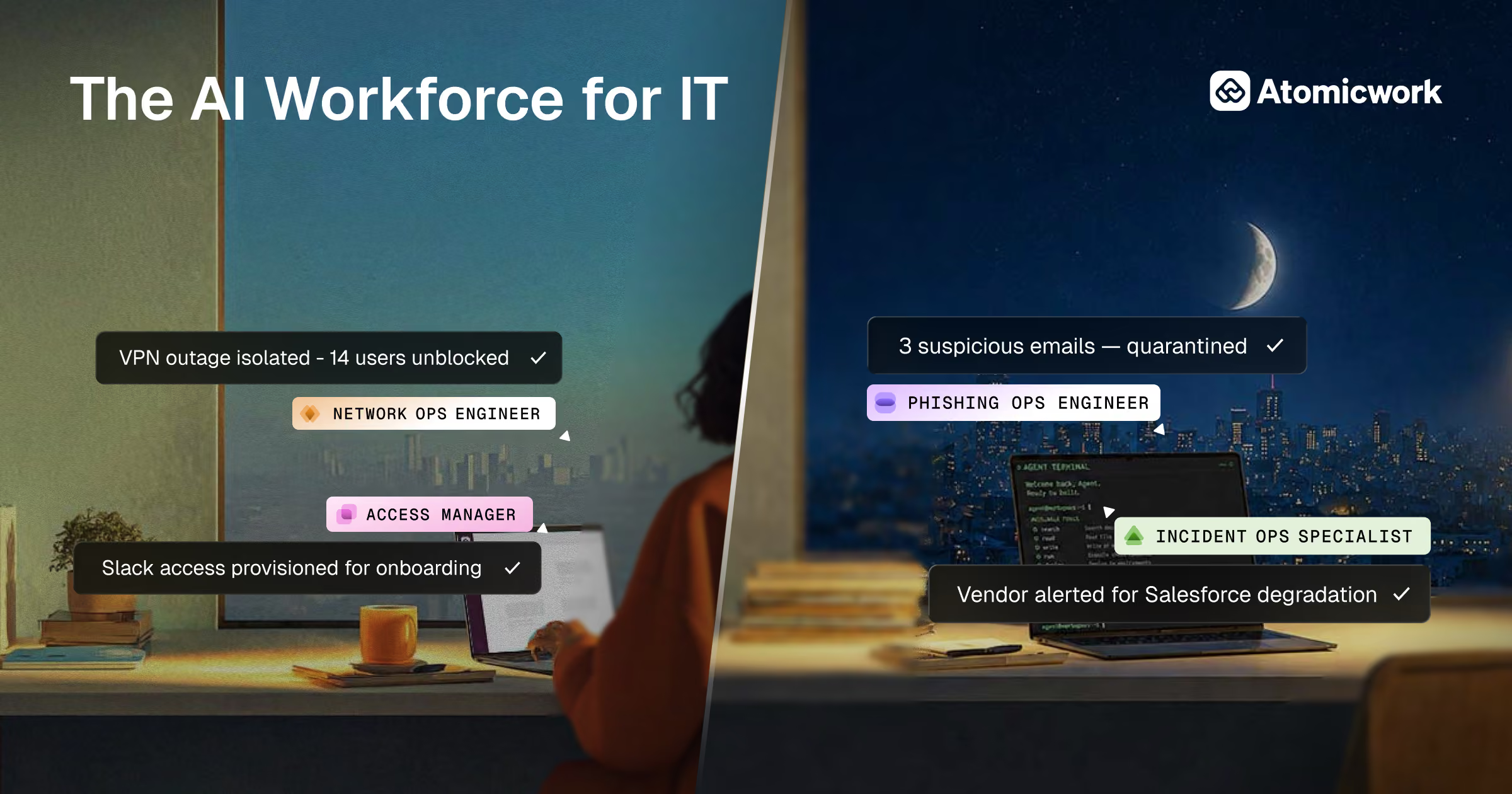
After Atom and Access Ops Manager, Mark and Aaron both have their next 2 AI Coworkers lined up.
Mark is building a network engineer AI Coworker that spots Wi-Fi and access point issues in tickets and eventually fixes them:
If I have an access point that's not responding, it's okay to let it reboot. It's okay to let it push firmware. It's okay to let it do things in our infrastructure. So I'm super excited about that. — Mark Gill, Zuora
There are five or six more use cases behind it, which he calls Zuora's "agentic army."
Aaron is going after two. One for security: a user reports a suspected phishing email, the AI Coworker handles classification and context, pulls a human in only where judgment is genuinely required, and runs the deterministic cleanup itself instead of paging infrastructure to block an address. One for triage, because "users aren't always great at explaining what the problem is" — so the first pass happens before an agent opens the ticket, and what they open is already understood.
Aparna summed up the panel's playbook for moving AI coworkers from pilot to production:
- Give every AI coworker a clear job, owner andboundary. If you can't say what it does and who owns it, it isn't ready.
- Design for safe failure. Assume it willget something wrong and decide now what happens when it does.
- Treat identity and access as first-class.Not an integration you add later — this is the foundation the AI Coworkerstands on.
- Instrument everything. If you can'treconstruct what it did, you can't defend it.
- Get the underlying systems ready. Data,knowledge, approval matrices.
- Roll out progressively. Highest volumeand best understood usecases first.
- Think about handoff. Most real work ispart automated and part human. The seam is where the experience breaks.
To drive adoption, this is how they led the charge:
- Bring other departments in early, so they own the decision and the change plan with you.
- Lead by example. Build the templates that work, then let other teams copy them.
- Start with high-volume, well-understood work — access requests, your top 25 — where an AI Coworker can earn trust fast.
- Treat governance as ongoing. Define what good looks like, then keep measuring against it.
- Find executive champions who will talk about wins in public, by name
That's how Zuora managed to not just cut their ticket volume by 50% but also win a Gartner Eye on Innovation Award for the Midsized Enterprise for their Digital Workplace Experience in 2025, and how Lightmatter automated over 80% of their access requests.
Want to see what an AI workforce could do for your IT team? Talk to us at atomicwork.com!