If you’re an IT Ops team buying AI-driven service management this year, the hard part isn’t finding a tool that says “AI.” It’s telling which platforms resolve a request end to end and which ones just talk about it.
By Gartner’s estimate, thousands of vendors now claim “agentic AI,” only a few are the real thing, and more than 40% of agentic AI projects will be scrapped by 2027. The industry has a name for the rest — agent-washing.
This guide compares seven platforms that take AI in service management seriously — what each one’s AI actually does, how autonomous it really is, what it costs, and where it falls short.
First, a quick definition so we’re working from the same map. AI-driven service management uses AI — conversational agents, autonomous workflows, and predictive analytics — to handle ticketing, incident response, and change management for IT operations teams, ideally resolving common requests without a person touching every step.
Copilot, agent, or AIOps? Three very different things wearing one label
Most of the confusion in this market comes from three distinct technologies getting filed under the same “AI” banner. They do different jobs, and the difference is the single most useful thing to hold in your head while you evaluate.
- AI copilot — assists a human. It drafts replies, summarizes long threads, and suggests next steps. A person still does the actual resolving. Most “AI” in legacy ITSM lives here.
- AI agent (agentic) — interprets the request, plans, and acts on it: provisions the access, resets the account, runs the workflow, and escalates only the exceptions. No human in the loop for the routine stuff. This is the category Gartner is pointing at — and the one most vendors are still only approaching.
- AIOps — applies machine learning to operational signals: correlating alerts, cutting noise, predicting incidents before they page someone. It’s about keeping infrastructure healthy, not resolving an employee’s request. Different job, often a different buyer.
A platform can do more than one of these. The question to keep asking is which one a given feature actually is — because “our AI summarizes the incident” and “our AI resolves the incident” are separated by the entire distance this market is trying to cross.
The three levels of autonomy
Even within genuinely agentic platforms, autonomy is a dial, not a switch. The teams getting real results tend to move through it in stages rather than flipping everything to “autonomous” on day one:
- Assistive — the AI deflects and answers from your knowledge base, but routes anything real to a human.
- Assisted — the AI does most of the work and a human approves the final action. A good trust-building middle gear.
- Autonomous — the AI resolves defined, high-volume request types end to end, and you measure it on resolution rate, not deflection alone.
Whichever platform you pick, ask how it handles that progression — and whether autonomy is something you configure per request type or a checkbox the vendor flips in a demo and never again.
The 7 best AI-driven service management platforms for 2026
These are ordered to show the range — from agentic-native to agentic-on-incumbent to AIOps — not as a strict ranking. Match the autonomy level and category to what your team actually needs.
1. Atomicwork
Atomicwork is an AI-native, resolution-first service management platform built so the AI does the work rather than assisting a human who does it.
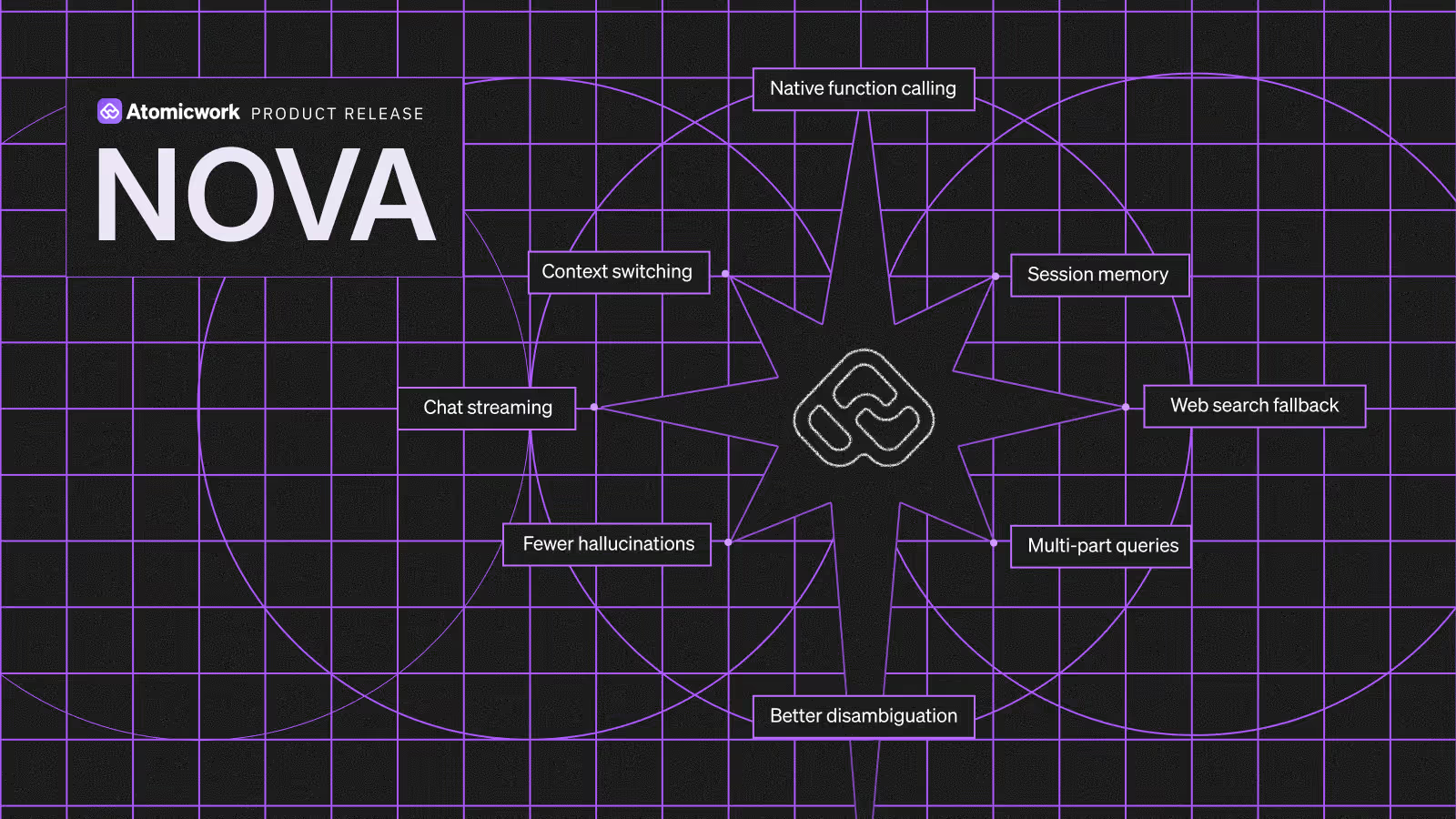
- What the AI does: Atomicwork runs on an AI Workforce — governed AI Coworkers that own a service function end to end, not one-off tasks. Each Coworker has a defined job role, scoped access, a budget, a human manager, and a full audit trail, so IT runs them the way HR runs people. They pick up a request in Slack or Teams, pull context across IT, HR, and Finance systems, take the action — provision access, run the RCA, reset an account, resolve the incident — and escalate only the exceptions.
- Autonomy level: Agentic — autonomous for defined, high-volume request types.
- Best for: Mid-market to enterprise IT teams replacing portal-based, legacy ITSM with AI-native service management.
- Pricing: Outcome- or usage-based; Professional from $25K/year. Runs on top of ServiceNow or Jira Service Management with no platform fee, so you can start without a migration. (pricing)
- Where it falls short: As a newer platform, its third-party marketplace is smaller than ServiceNow’s or Atlassian’s, and it’s built for cloud-first teams — not the right fit if you need heavy on-prem deployment or want to preserve deep ServiceNow customization as-is.
2. ServiceNow
ServiceNow is the enterprise incumbent, and its AI story now runs through Otto — the agentic experience it unveiled at Knowledge 2026 and is positioning as the center of gravity for enterprise AI.
- What the AI does: Otto is a single AI experience — conversational AI, enterprise search, voice, and autonomous workflows — that interprets a request, routes it to the right AI agent, and executes it end to end across systems. It’s powered by Moveworks intelligence (ServiceNow closed that acquisition in December 2025), governed by AI Control Tower, and fronted through EmployeeWorks; the older Now Assist copilot still handles in-workflow summarizing and drafting beneath it. ServiceNow says its own internal deployment resolves more than 90% of employee IT requests, 99% faster than human agents.
- Autonomy level: Agentic — Otto is ServiceNow’s deliberate move from copilot to end-to-end execution, what CEO Bill McDermott calls “the AI agent of agents.”
- Best for: Large enterprises already standardized on ServiceNow that want AI to staff L1 support and execute across IT, HR, and beyond.
- Pricing: Custom / quote; the agentic tiers (Now Assist Prime, Moveworks Prime) sit at the top of the pricing stack.
- Where it falls short: Otto’s execution and search are strongest inside the ServiceNow ecosystem, and — like all agentic AI — depend on clean data and well-structured workflows underneath; MIT research on enterprise AI pilots found the majority of failures trace to data and integration gaps, not the models. High total cost of ownership and multi-quarter implementations still apply.
Moveworks is still sold as a standalone product for now, but its roadmap is now ServiceNow’s — if you’re not a ServiceNow shop, evaluate it as part of the Otto story rather than an independent bet.
3. Aisera
Aisera is a generative-AI service platform built around request deflection and knowledge automation at scale.
- What the AI does: Generative AI assistants resolve repetitive IT requests, automate FAQ and knowledge-base answers, and handle chat-based troubleshooting and provisioning across channels.
- Autonomy level: Agentic for well-trained, knowledge-heavy flows.
- Best for: Large ITSM teams in knowledge-intensive environments focused on deflection.
- Pricing: Custom / quote.
- Where it falls short: Results lean heavily on the quality and freshness of your knowledge base; thin or stale content caps what it can resolve.
4. Ivanti Neurons for ITSM
Ivanti Neurons for ITSM is a modernizing incumbent and the destination Ivanti is steering Cherwell customers toward ahead of that platform’s end-of-life at the close of 2026.
- What the AI does: AI for intelligent routing, ticket deflection, and root-cause analysis, paired with strong asset and endpoint management and self-healing automation.
- Autonomy level: Copilot to assisted, with AIOps-style automation.
- Best for: Organizations balancing IT service and asset management, and Cherwell shops planning a migration.
- Pricing: Custom / quote.
- Where it falls short: AI capabilities trail the agentic-native leaders, and the platform carries the complexity of a broad, long-established product line.
5. Freshservice
Freshservice, from Freshworks, is the fast-to-deploy, ITIL-aligned choice for teams that want quick AI time-to-value.
- What the AI does: Freddy AI powers ticket automation, agent-assist drafting, and an AI agent for self-service deflection across channels.
- Autonomy level: Copilot, with deflection-focused automation.
- Best for: SMB and mid-market IT teams wanting modern ITSM without a heavy implementation.
- Pricing: From $19/agent/month; Freddy AI is largely a paid add-on on top of the per-agent tiers. (pricing)
- Where it falls short: The most useful AI sits behind add-ons and higher tiers, so real cost climbs well past the entry price.
6. Jira Service Management
Jira Service Management, from Atlassian, is the natural fit for DevOps-aligned teams already living in the Atlassian stack.
- What the AI does: Rovo AI brings virtual agents, smart triage, summarization, and search; ticket routing and incident workflows tie tightly into Jira and Confluence.
- Autonomy level: Copilot, with a virtual agent for deflection.
- Best for: Engineering and DevOps-driven teams managing IT and development work together.
- Pricing: Free for up to 3 agents; Standard ~$20/agent/month; the AI virtual agent requires Premium at ~$51/agent/month. (pricing)
- Where it falls short: Full AI is gated to Premium with conversation caps, configuration gets complex, and value drops outside the Atlassian ecosystem.
7. PagerDuty
PagerDuty is the incident and alert-management leader, and the clearest example of AIOps rather than request resolution on this list.
- What the AI does: AIOps groups related alerts, cuts notification noise, and surfaces probable causes; its Copilot helps build automation and runbooks.
- Autonomy level: AIOps plus copilot.
- Best for: Teams with high incident volume and complex on-call and notification needs.
- Pricing: Per-user; advanced AIOps and Copilot are premium add-ons (quote).
- Where it falls short: It manages incidents brilliantly but isn’t built to resolve everyday employee service requests — a complement to an ITSM platform, not a replacement for one.
How to tell real agentic AI from agent-washing in a demo
Every vendor on every list will say “agentic.” Here’s what to actually ask, so you leave the demo knowing which side of the line you’re looking at:
- “Show me one request from intake to resolution with no human touching it.” Copilots stop at a suggestion. Agents close the loop.
- “Two employees report the same issue in different channels. What happens?” Agentic systems cluster into one. Ticket engines open two.
- “Who writes the resolution and takes the action?” “Your team, faster” means copilot. “The system, then you approve” means agent.
- “What did the AI do last week with no one prompting it?” No answer means it’s reactive, not autonomous.
- “How is the AI priced — included, per-agent, or per-resolution?” The answer tells you how the vendor really thinks about autonomy.
What outcomes to actually expect
Treat vendor deflection numbers as ceilings, not promises. Well-implemented conversational automation commonly deflects somewhere in the 20–60% range of tier-1 volume depending on how clean your knowledge and request data are. The teams that hit the high end share a pattern: a unified data model, genuine agentic resolution rather than relabeled chat, and a phased rollout that earns trust before scaling. Gartner’s own warning that 40%+ of agentic AI projects will be canceled by 2027 is mostly a story about teams that skipped those fundamentals. Measure resolution rate, not just deflection — a tool that closes tickets faster while volume stays flat isn’t actually removing work.
Where to go from here
If you’re comparing the broader market — including the established ITSM platforms that aren’t primarily AI-driven — start with our companion guide to the best ITSM tools for 2026. This page is the agentic-AI cut of that landscape; that one is the full category view.
And if the through-line here resonates — that the point of AI in service management is to resolve work, not narrate it — that’s the bet Atomicwork’s AI Workforce is built on. Talk to our team if you’d like to see what autonomous resolution looks like on your own request data.


.avif)